The sub-$300 bracket is where open-back headphones transition from “curiosity” to “serious audio tool.” Below $100, compromises in driver quality limit what’s possible. Between $100 and $200, you start to encounter genuinely competent open-back headphones that will honestly impress you. Between $200 and $300, you’re in mid-fi territory — the overlap zone where audiophile performance starts to converge with enthusiast expectations, and where the differences between $300 and $1,000 headphones begin to shrink to smaller increments.
This guide focuses on the best open-back headphones available in 2026 for under $300, with specific attention to use case, sound signature, and source requirements.
Why Open-Back Under $300?
Before diving into picks: what to actually expect at this price tier, and what to understand about open-back headphones specifically.
Open-back headphones vent the rear of their earcups to the room, which eliminates the acoustic coloration that sealed designs produce. The result is a wider, more natural soundstage, more accurate imaging, and more linear bass than closed-back alternatives — but with zero noise isolation and significant sound leakage in both directions. They are not practical for public transport, shared offices without headphone culture, or recording with a microphone in the room.
If you need isolation, this is the wrong buying guide. Look instead at closed-back recommendations in this price range, where the Beyerdynamic DT 770 Pro remains the benchmark.
1. Sennheiser HD 560S — The Reference Neutral Under $200
Sennheiser HD 560S
Driver type: 38mm dynamic, open-back
Impedance: 120Ω
Sensitivity: 110 dB/Vrms
Frequency response: 6Hz – 38,000Hz
Street price: ~$150–180
The Sennheiser HD 560S is the most technically accurate open-back headphone under $200 in 2026, and probably under $250 as well. Its Harman-target-aligned tuning delivers honest, uncolored reproduction that serves critical listening, mixing, and any application where accuracy matters more than excitement.
The bass is present and extended without artificial emphasis. The midrange is the HD 560S’s signature strength: clear, defined, and present — vocals and acoustic instruments sound natural and correctly proportioned. The treble is bright enough to reveal recording detail without causing significant fatigue on well-mastered material, though it can expose harsh recordings mercilessly.
For comfort, the HD 560S is exceptional. At ~240g with velour earpads and an effortless self-adjusting headband, it’s one of the lightest and most wearable headphones in any bracket. Long listening sessions — four, five, six hours — are genuinely comfortable.
The 120Ω impedance sits in a practical middle ground: it doesn’t require a massive amplifier stack like a 300Ω Sennheiser, but benefits meaningfully from a proper source over a laptop or phone output. A budget dongle DAC provides adequate drive; a small desktop DAC/amp noticeably improves dynamics and separation.
For the listener who wants the most accurate reference at the best price — or who is starting their open-back journey and wants to understand what neutral sounds like — the HD 560S is the default recommendation in this tier.
Full review: Sennheiser HD 560S Review 2026
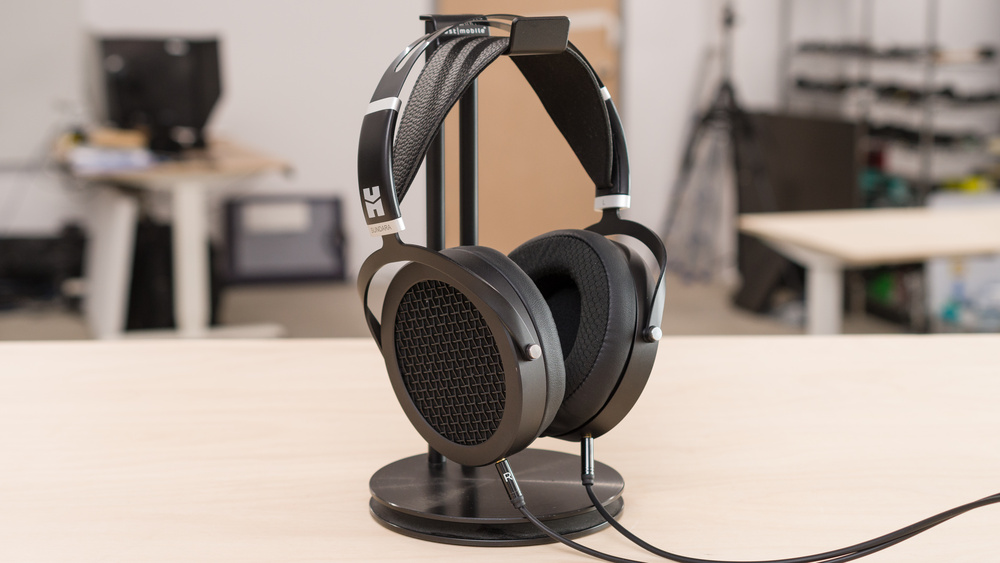
2. HiFiMAN Sundara — Planar Performance Under $350 (Often on Sale Under $280)
HiFiMAN Sundara on Amazon
Driver type: Planar magnetic
Impedance: 37Ω
Sensitivity: 94 dB/mW
Frequency response: 6Hz – 75,000Hz
Street price: ~$250–350 (sale prices frequently hit $250–280)
The HiFiMAN Sundara regularly dips into sub-$300 territory on sale, and when it does, it represents arguably the best value in the entire open-back headphone market. The planar magnetic driver delivers transient speed and bass texture that dynamic driver headphones at this price cannot match.
The Sundara’s sound signature is neutral-to-bright. Its bass is defined and textured — not the most impactful in terms of quantity, but distinctively controlled and fast in character. The midrange is clear and natural. The treble has the brightness characteristic of planar headphones: detailed, extended, and occasionally pushing toward sharp on poor recordings.
The soundstage is wide — wider and more accurate in spatial geometry than the HD 560S — and the imaging is precise enough for competitive gaming, critical listening, and mixing reference. For music genres where transient speed matters — jazz, rock, acoustic music, electronic — the Sundara is noticeably more engaging than dynamic alternatives in this price range.
The HiFiMAN build quality is the main compromise: the adjustment mechanism is functional but not premium, and the overall construction doesn’t match the solidity of Sennheiser or Beyerdynamic. At 94dB sensitivity, it needs a proper source — a phone alone won’t cut it.
For a full breakdown, read the HiFiMAN Sundara Review 2026.
3. Beyerdynamic DT 900 Pro X — Studio Precision with Beyerdynamic Comfort
Beyerdynamic DT 900 Pro X on Amazon
Driver type: 45mm dynamic (Tesla driver)
Impedance: 48Ω
Sensitivity: 100 dB SPL (1mW/500Hz)
Frequency response: 5Hz – 40,000Hz
Street price: ~$250–300
The DT 900 Pro X is Beyerdynamic’s answer to a specific question: what if the DT 990 Pro’s legendary build quality and comfort were paired with a modern, studio-accurate flat tuning rather than the V-shaped consumer signature?
The result is a headphone with Beyerdynamic’s characteristic velour comfort, replaceable parts, and German build durability — but with a much more neutral, linear frequency response than the DT 990 Pro. The bass is natural and extended without the V-shaped boost. The treble, while still having Beyerdynamic energy and presence, is better integrated and more consistently musical than the older DT 990 Pro’s sharp peaks.
The soundstage is wide — characteristic of the open-back Beyerdynamic design — and the imaging is sharp enough for mixing reference or gaming positional audio. At 48Ω and 100dB sensitivity, the DT 900 Pro X is more source-friendly than the Sundara and more forgiving of modest amplification.
For the listener who wants Beyerdynamic comfort and durability with a more studio-accurate sound than the DT 990 Pro provides — or for mixing engineers who want a reliable, comfortable reference headphone — the DT 900 Pro X is the natural choice.
Source Requirements — Don’t Skip This
Every headphone in this guide benefits from proper amplification. Here’s the minimum viable source for each:
- HD 560S: A quality dongle DAC (FiiO KA3, Apple USB-C adapter) is the minimum. A small desktop DAC/amp (Topping L30 + E30, Schiit Modi+Magni) is better.
- HiFiMAN Sundara: Don’t try to drive this from a phone. A quality dongle DAC is the minimum; a desktop DAC/amp opens the dynamics considerably.
- DT 900 Pro X: Most source-friendly of the three — a decent dongle gets you there, though a desktop stack improves the experience.
For a complete guide to amplification options and what to look for, read How to Choose a Headphone Amplifier 2026.
Buying Summary
| Headphone | Best for | Sound character | Source requirement |
|---|---|---|---|
| Sennheiser HD 560S | Accuracy, mixing, neutral reference | Neutral-bright | Modest — dongle works |
| HiFiMAN Sundara | Planar speed, wide staging, acoustic music | Neutral-bright, fast | Needs proper source |
| DT 900 Pro X | Long sessions, comfort, neutral studio work | Neutral, wide stage | Moderate — dongle to desktop |
All three represent genuine high-fidelity performance at accessible prices. None of them will disappoint a listener upgrading from consumer headphones — the step up in resolution, soundstage, and tonal honesty is immediately and dramatically apparent.