Topping has built their entire reputation in the audiophile world on one premise: “Measurement-led engineering.” Topping’s devices aim for functional transparency—the goal is for the device to have zero impact on the audio signal other than the necessary conversion and amplification. In the Topping DX3 Pro+, that philosophy hit a sweet spot that redefined the budget desktop DAC/amplifier market. Even in 2026, it remains a benchmark for transparency, utility, and cost-effectiveness.
The DX3 Pro+ is small, clean, and unpretentious. It doesn’t promise to “warm up” your sound or add “musical character”—it promises to stay out of the way. For listeners who want a clean, accurate foundation for their desktop setup, that’s exactly what’s required.
Technical Specifications
| Spec | Value |
|---|---|
| DAC Chip | ESS ES9038Q2M |
| Output Power | 1800 mW at 32 Ω |
| THD+N | < 0.00015% (at 1 kHz) |
| SNR | > 120 dB |
| Output Impedance | < 0.1 Ω |
| Inputs | USB, Coaxial, Optical, Bluetooth (LDAC) |
| Outputs | 3.5mm (unbalanced), RCA |
The technical performance is class-leading for the price. A THD+N of < 0.00015% is essentially invisible to the human ear. The SNR of > 120 dB ensures a background that is functionally silent even with sensitive IEMs. The 1800 mW of output power is surprising for such a small, non-obtrusive device; it drives almost anything that isn’t an intentionally high-impedance, low-sensitivity outlier.
Design and Build
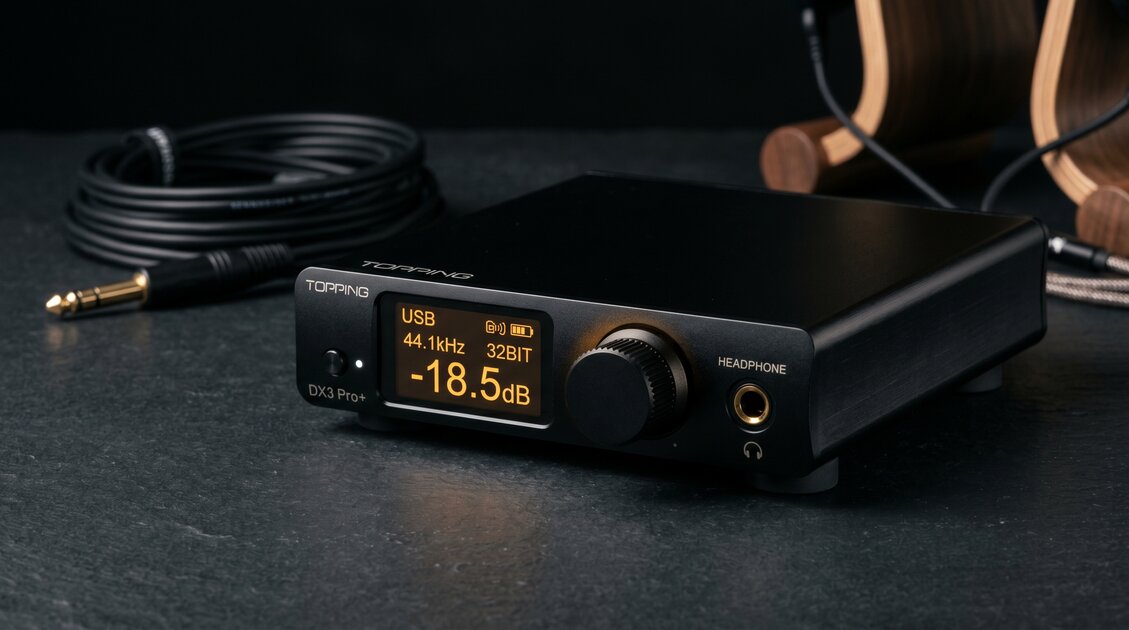
The DX3 Pro+ is remarkably small—roughly the size of two decks of cards stacked. It features a clean, minimalist aluminum chassis with a small OLED screen that displays sample rate, volume, and input status. The interface is operated via a front-mounted volume knob that doubles as a menu navigator.
The build is utilitarian but well-executed. It doesn’t have the “luxury” feel of boutique audio gear, but it feels like a precision tool. It fits into desk setups, behind monitors, or in cramped workspace configurations where larger desktop stacks are impossible.
Sound Signature
Transparency and Detail
The DX3 Pro+ sounds… like nothing. And that is the point. It is the definition of a “wire with gain.” High frequencies are crisp, clean, and detailed without being bright or fatiguing; the midrange is open and transparent; the bass is fast, controlled, and well-extended.
If you have a headphone with a distinct sound character—like a Sennheiser HD 650—the DX3 Pro+ will let the headphone’s character define the sound. If you prefer your signal chain to contribute its own flavor, you will find the DX3 Pro+ boring. If you prefer to know exactly what is in your recording, you will find it ideal.
Soundstage
Spatial performance is tight and precise. It doesn’t artificially widen the image, but it doesn’t compress it either. It gives you exactly the spatial cues that are present in the recording and the transducer.
Key Features
- Small Footprint: Its physical size is its most underrated feature. It disappears into a workspace.
- Bluetooth: Includes support for high-quality codecs including LDAC, which is genuinely useful for casual listening from a smartphone or tablet.
- Utility: Acts as a DAC/amp, a dedicated DAC (with volume bypass for external amps), and a Bluetooth receiver.
- Price: At under $200, it makes the barrier for entry to high-fidelity desktop sound almost non-existent.
Who Should Buy the DX3 Pro+?
- Anyone who wants a clean, transparent, high-performance desktop DAC/amp without the footprint or the price of larger stacks
- Listeners with limited desk space who need a compact solution
- Those with multiple digital sources (USB for PC, Optical for console, Bluetooth for phone)
- Audiophiles who prioritize technical measurements and transparency over additive coloration
- Users needing a high-quality, budget-friendly DAC/amp for a pair of Sennheiser HD 560S or similar dynamic headphones
Who Should NOT Buy the DX3 Pro+?
- Users who want a “warm,” “analog,” or “musical” sound character—the DX3 Pro+ is neutral and analytical
- Those needing balanced output (4.4mm or XLR)—the DX3 Pro+ only has a 3.5mm unbalanced output
- Anyone with power-hungry planar magnetic headphones that require balanced power for best performance—consider the FiiO K7
- Users who need complex DSP or analog bass enhancement—consider the iFi ZEN DAC V3
Pros & Cons
Pros:
- Class-leading technical measurements (transparency, SNR, THD)
- Extremely compact—fits anywhere
- Full-featured: acts as a DAC/amp, pure DAC, or Bluetooth receiver
- Excellent value proposition for the performance offered
- Neutral, transparent character lets your headphones’ own sound shine
Cons:
- Unbalanced 3.5mm only—no balanced output
- Utilitarian aesthetic—not a “luxury” object
- Sound signature is purely analytical—may feel “boring” to some listeners
- Volume knob/navigation interface is functional but fiddly for frequent adjustments
Frequently Asked Questions
Q: Is it enough power for my headphones?
For dynamic driver headphones, yes. For almost any planar magnetic headphone up to Arya-level performance, yes. If you have extremely difficult-to-drive, high-impedance vintage headphones or specialized power-hungry planars, you might want more current headroom, but for 95% of audiophile gear, 1800mW is sufficient.
Q: Can I use it as a DAC for my integrated amplifier?
Yes, you can set the volume to bypass/line-out mode and use it as a high-quality dedicated DAC for a loudspeaker system.
Conclusion
The Topping DX3 Pro+ remains a benchmark in desktop audio for one reason: it delivers technical perfection at a price that almost anyone can afford. It doesn’t try to be a boutique object; it doesn’t try to solve acoustic problems with added coloration; it just provides a clean, neutral, powerful signal. For anyone building a workspace system who needs transparency, utility, and an unobtrusive footprint, the DX3 Pro+ is still the benchmark.