Topping’s A90 Discrete amplifier is a masterclass in modern solid-state engineering. In an era where many amplifiers use integrated operational amplifiers (op-amps) to manage the signal path, the A90 Discrete uses a fully discrete NFCA (Nested Feedback Composite Amplifier) module. By replacing the generic op-amp with custom-tuned, individual discrete components, Topping gained the ability to fine-tune every aspect of the amplifier’s response—achieving levels of current delivery, noise suppression, and signal linearity that generic op-amps struggle to match.
In 2026, the A90 Discrete remains one of the cleanest, most powerful amplifiers available for desktop users. Whether you are driving demanding planars like the HiFiMAN Arya or highly sensitive IEMs, the A90 Discrete delivers a level of performance that fundamentally challenges the necessity of significantly more expensive boutique options.
Technical Specifications
| Spec | Value |
|---|---|
| Amp Technology | Fully Discrete NFCA (Nested Feedback Composite Amplifier) |
| Output Power | 9800 mW at 16 Ω |
| THD+N | < 0.00005% |
| SNR | > 145 dB |
| Output Impedance | < 0.1 Ω |
| Gain Settings | Low (-12.8 dB), Medium (0 dB), High (+13.9 dB) |
| Inputs | Balanced (XLR), Unbalanced (RCA) |
| Outputs | 4-pin XLR, 4.4mm, 6.35mm, RCA (Pre-amp) |
The numbers are staggering. A THD+N of < 0.00005% is practically perfect. The signal-to-noise ratio of 145 dB ensures a black background that makes the A90 Discrete a perfect partner for the most sensitive IEMs imaginable. With nearly 10 watts per channel at 16 ohms, there is essentially no headphone on the market—no matter how demanding, no matter how current-hungry—that the A90 Discrete cannot drive to its full potential.
Design and Build
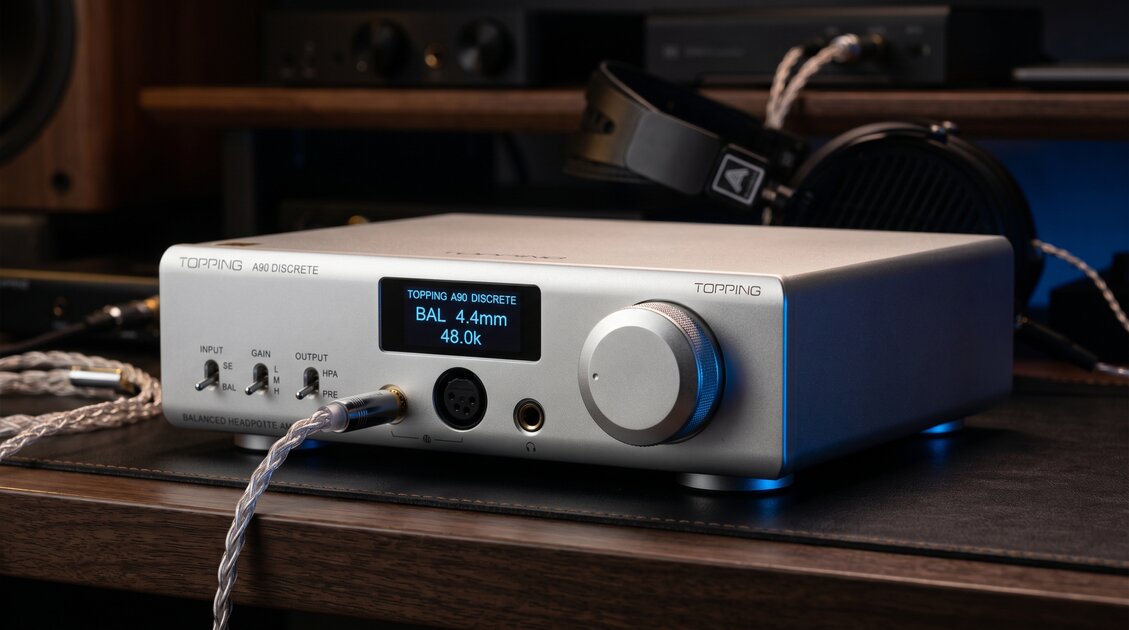
The A90 Discrete is an industrial-grade object. It features a heavy, CNC-machined aluminum chassis, a clear OLED display, and high-quality relays for volume and switching that provide a satisfying “click” during operation. It feels substantial, reliable, and deliberate.
The interface is comprehensive: input selection, gain control, output mode (Headphone, Pre-amp), and a clear display showing the volume level and signal path. The front panel includes both balanced (4-pin XLR, 4.4mm) and unbalanced (6.35mm) outputs, making it compatible with any cable configuration.
Sound Signature
Transparency and Linearity
The A90 Discrete is, above all else, completely neutral. It adds nothing to the music and takes nothing away. If your source material is warm, the A90 Discrete will sound warm. If your recording is bright, the A90 Discrete will sound bright. It is the definition of a “wire with gain.”
Dynamic Control
This is the amp’s real-world advantage. The NFCA module’s current delivery makes dynamic shifts feel immediate. Whether it’s a sudden kick drum, a rapid-fire electronic percussion sequence, or the explosive orchestral transition in a classical recording, the A90 Discrete handles transients with such control that the music feels more alive and present.
Noise Floor
The SNR of 145 dB is functionally silent. Using high-sensitivity, low-impedance IEMs—a scenario where most amplifiers reveal their noise floor as audible hiss—the A90 Discrete remains completely silent. It creates an empty, black background against which the music exists.
Who Should Buy the A90 Discrete?
- Audiophiles who want an “end-game” solid-state amplifier that will drive any headphone they ever buy
- Listeners who prize analytical precision, extreme transparency, and complete lack of coloration
- Users with multiple headphones (balanced/unbalanced) who need a central, versatile desktop anchor
- Users who need both a headphone amplifier and a high-quality pre-amplifier for active monitors
- Listeners with extremely sensitive IEMs who demand a hiss-free listening experience
Who Should NOT Buy the A90 Discrete?
- Those looking for tube-amp warmth, musical color, or “flavor”—the A90 Discrete is strictly transparent
- Users with a limited desktop budget—the A90 Discrete’s technical overkill is unnecessary for most entry-level headphone setups
- Those who want a plug-and-play desktop stack—this is a dedicated amplifier that requires a separate DAC
- Listeners who find analytical, transparent gear “boring” or clinical
Pros & Cons
Pros:
- Industry-leading technical performance (THD+N, SNR, Power)
- Fully discrete NFCA design offers superb linearity and transient control
- Versatile output options (XLR, 4.4mm, 6.35mm) and pre-amp functionality
- Completely silent background—perfect for sensitive IEMs
- Drives any headphone on the market without sweat
Cons:
- Transparent, neutral signature will not appeal to fans of “colored” or “warm” sound
- Requires a separate DAC to function
- High technical performance is “overkill” for most common dynamic driver headphones
- Price point is significant for a dedicated amplifier
Frequently Asked Questions
Q: Is the A90 Discrete overkill for my setup?
If you are using high-end planar magnetic headphones or ultra-sensitive IEMs, no. If you are using standard dynamic-driver headphones and don’t plan to upgrade, the technical performance of the A90 Discrete may be more than you need. It is an “end-game” device; you buy it so that you never have to worry about amplification again.
Q: Does it pair well with my DAC?
It pairs well with any high-quality DAC. Because the A90 Discrete is so transparent, you will hear the quality of your DAC’s analog output stage. If your DAC is a high-resolution, neutral device, the A90 Discrete will faithfully reproduce that sound.
Conclusion
The Topping A90 Discrete remains a powerhouse because it achieves the ultimate objective of solid-state amplification: it provides clean, powerful, and precise signal delivery that respects the integrity of the input. It doesn’t color the sound, it doesn’t struggle with difficult loads, and it doesn’t introduce noise. For listeners who want a system that presents music with absolute fidelity, or for those who want to ensure their amplification chain will never be the bottleneck for any current or future headphone purchase, the A90 Discrete is the gold standard. It’s an essential tool for an enthusiast who demands the truth.