The Sony WH-1000XM6 arrives as the latest iteration in a lineage that has dominated the premium wireless ANC market for years. Following the controversial XM5 — which traded the XM4’s foldable design for a sleeker but less portable aesthetic — the XM6 walks a careful line between refinement and reinvention. It keeps the overall design language of the XM5 while addressing the most persistent criticisms: build quality concerns, the lack of folding hinges, and tuning that some found overly bass-heavy out of the box.
For anyone coming from the XM4 or earlier models, the XM6 represents a significant leap in ANC performance, battery life, and overall polish. For XM5 holdouts, the improvements are more evolutionary — better ANC processing, slightly warmer-neutral tuning, and a more robust physical build — but they accumulate into the most complete wireless ANC package Sony has delivered yet.
Specifications
| Spec | Value |
|---|---|
| Driver Type | 30 mm dome-type (CCAW voice coil) |
| Impedance | 16 Ω (at 1 kHz) |
| Sensitivity | 102 dB / 1 mW |
| Frequency Response | 4 Hz – 40 kHz (LDAC), 20 Hz – 20 kHz (AAC) |
| Weight | ~250 g |
| Battery Life | 40 hours (ANC on), 50 hours (ANC off) |
| Quick Charge | 3 minutes for 3 hours playback |
| Bluetooth | 5.3 with LDAC, AAC, SBC |
| Multipoint | Yes, up to 2 devices |
| ANC | Dual Noise Sensor QN1e HD |
| Codec Support | LDAC (up to 990 kbps), AAC, SBC |
| Inputs | USB-C (charging + audio), 3.5 mm analog |
| Case | Hard-shell carrying case |
The XM6 continues Sony’s tradition of excellent source flexibility. The 16-ohm impedance and 102 dB sensitivity mean even a basic smartphone drives them to loud volumes without breaking a sweat. The headline improvement is the QN1e HD processor — an evolution of the long-running QN1 chip that improves ANC sampling rate and real-time adaptive filtering. On the codec side, LDAC remains the gold standard for Android users, while iPhone users will rely on AAC — which the XM6 handles with notably consistent bitrate compared to some competitors that struggle with Apple’s implementation.
Design and Build
The XM6 retains the streamlined, minimalist silhouette of the XM5 but adds meaningful structural improvements. The headband now features a thicker, more evenly distributed cushion that reduces pressure points during extended wear — one of the most common complaints about the XM5’s narrower headband padding. The yoke mechanism has also been redesigned with reinforced metal inserts, addressing the creaking and flex that developed over time on the XM5’s all-plastic hinges.
Sony has not reintroduced the folding hinge from the XM4 era. The ear cups swivel flat for storage, but the headband does not collapse. This remains a polarizing decision — the XM6’s case is noticeably larger than the XM4’s compact carrying case, and travelers who pack light will feel the difference. That said, the new hard-shell case is more protective than the soft pouch that shipped with the XM5, and the flat-swivel design fits into most laptop bags without issue.
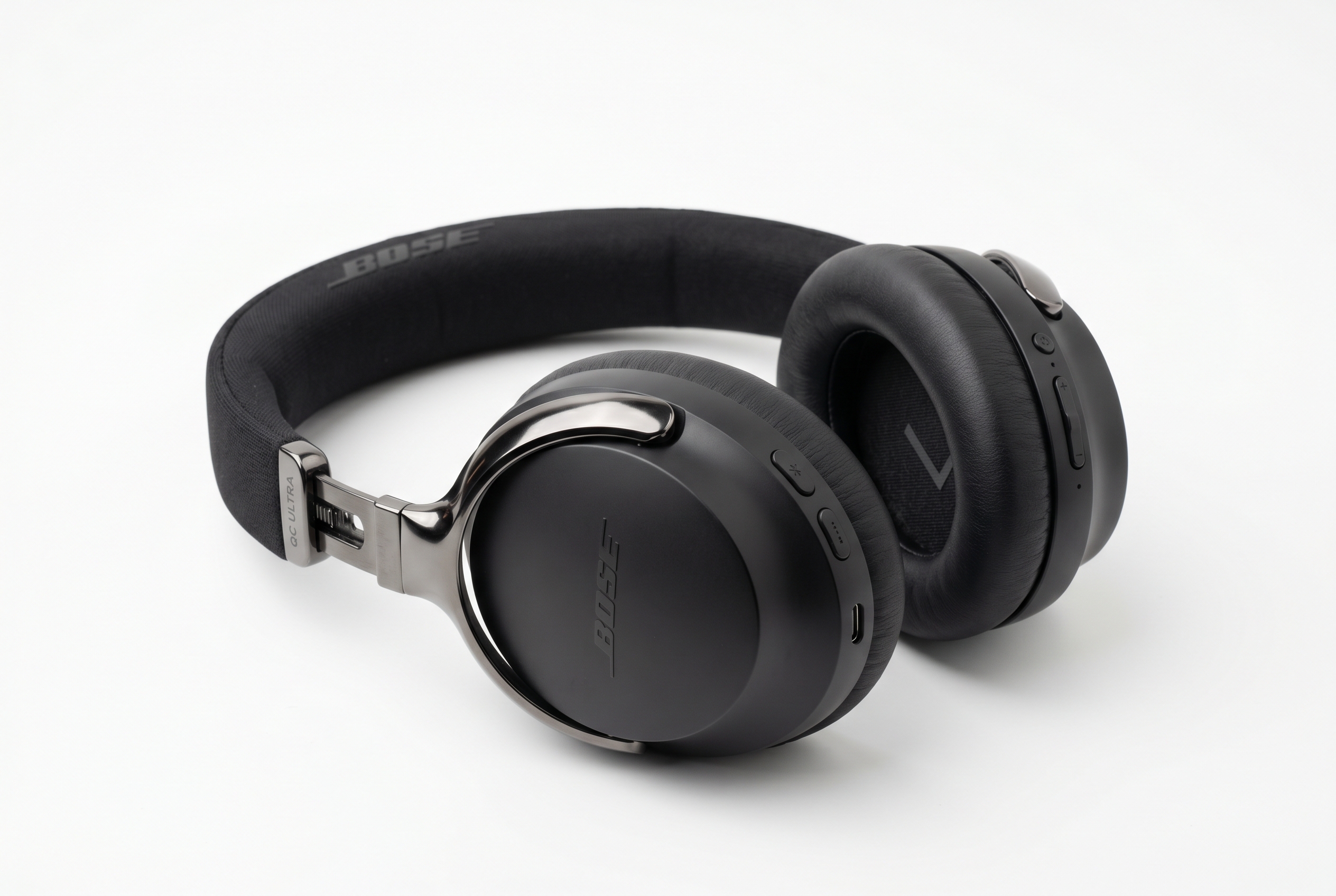
At approximately 250 g, the XM6 is lighter than the Bose QC Ultra (2nd Gen) and in the same range as the Apple AirPods Max — but with noticeably better weight distribution. The earpads use a new hybrid foam that combines memory foam with a stiffer inner core, providing a plush initial feel without collapsing over time. Clamp force is moderate: enough for a secure seal that preserves ANC performance, but not so tight that it fatigues after an hour.
The build quality is a clear step up from the XM5. The recycled plastic construction feels denser and more rigid, and Sony has eliminated the hinge wobble that developed in long-term XM5 units. Touch controls on the right ear cup remain responsive and intuitive, though the volume swipe gesture remains slightly less reliable than physical buttons in cold weather or with gloves.
Port selection is unchanged: USB-C for charging and digital audio, plus a 3.5 mm jack for analog passthrough. It is disappointing that Sony still omits a USB-C to 3.5 mm adapter in the box — the XM6 supports lossless USB-C audio up to 48 kHz / 16-bit, and the cable in the box is a standard USB-C to USB-C charging cable, not a break-out adapter for analog sources.
Sound Signature
Bass
The XM6’s bass tuning walks a careful line between the XM4’s generous low-end emphasis and the XM5’s somewhat recessed sub-bass. Out of the box, the default Sound Connect EQ presents a slightly elevated low shelf below 100 Hz — enough to give kick drums and synth bass satisfying weight without bleeding into the lower midrange. The 30 mm driver handles sub-bass extension cleanly down to around 20 Hz, though some of the physicality of planar magnetic bass is absent; this is a dynamic driver delivering punch and decay rather than the instantaneous attack of a planar.
What is genuinely improved is the bass response consistency across volume levels. The XM5 had a tendency to lose low-end weight at lower listening volumes due to the perceived loudness curve. The XM6’s driver tuning and DSP compensation keep the bass character stable from quiet nighttime listening to louder commuting volumes.
Midrange
The midrange is where the XM6 diverges most clearly from its predecessor. The upper midrange — especially the 2–4 kHz region — has been pulled back slightly compared to the XM5, which some listeners found shouty on certain vocal recordings. The result is a more natural, less fatiguing presentation that handles female vocals, acoustic guitars, and orchestral strings with better balance.
Lower midrange body is good but not exceptional. Male vocals have adequate weight and chestiness, though they lack the warmth and fullness you would get from a closed-back headphone like the Focal Bathys. The XM6’s midrange leans slightly cool-neutral in its default tuning, prioritizing clarity and separation over warmth. For listeners who prefer a richer midrange, the Sound Connect EQ’s “Vocal” preset or a gentle +1–2 dB low-shelf boost above 300 Hz brings back some body without muddying the presentation.
Detail retrieval in the midrange is competitive for a wireless ANC headphone. Micro-detail like breath intakes, string resonance, and subtle reverb tails are audible in good recordings — not at the level of a wired open-back like the HiFiMAN Sundara, but clearly better than the XM4 and a marginal improvement over the XM5.
Treble
The treble response has been re-tuned to address the XM5’s occasional brightness in the 6–8 kHz range. Cymbals and hi-hats have good shimmer and air without the sibilant edge that could make the XM5 uncomfortable on poorly mastered pop recordings. The 10 kHz and above region is gently rolled off — this is audible in the sense that extreme high-frequency air (ambient room sounds, extended harmonics) is slightly veiled compared to open-backed reference headphones, but it contributes to fatigue-free long listening sessions.
For an ANC headphone, the treble is well-executed. It is detailed enough to convey the texture of a ride cymbal or the sizzle of a brush snare, but it never calls attention to itself. The treble tuning trades absolute air for listenability, which is the right choice for a headphone that will primarily be used on commutes, in open offices, and during travel.
Soundstage
The soundstage is typical for a closed-back ANC headphone: moderately wide, with adequate left-right separation but limited depth perception. The XM6 does not break the closed-back ceiling — spatial cues mostly stay within the head stage rather than projecting convincingly in front of the listener. LDAC playback from high-resolution sources improves stereo separation slightly, but the physical limitation of closed-back isolation remains.
Sony’s 360 Reality Audio and head-tracking Spatial Sound features are available and work as advertised, with the head-tracking creating a convincing fixed-position soundstage that rotates with your head movement. For music mixed in immersive formats, this is genuinely impressive. For standard stereo content, the upscaling does not create the same illusion. The spatial processing is best reserved for native immersive content.
Source Pairing
The XM6 is designed for mobile-first use, and it works excellently with smartphones. Android users get the full LDAC experience at up to 990 kbps, which noticeably improves treble extension and soundstage clarity over AAC. iPhone users are limited to AAC, but the XM6’s implementation is one of the more stable AAC codec implementations available — fewer dropouts and more consistent bitrate than the Bose QC Ultra or Sennheiser Momentum 4.
The Sony Sound Connect app (formerly Headphones Connect) has been updated with a cleaner interface and improved auto-EQ features. The custom EQ now offers 10 bands instead of 5, providing much finer control over tonal balance. The adaptive sound control has also been improved — it learns your frequent locations (work, gym, home) and switches ANC profiles automatically, with noticeably faster transitions than the XM5.
USB-C audio is supported for lossless playback from a computer or compatible DAP. At 48 kHz / 16-bit, this is hi-res by wireless headphone standards and provides a noticeable improvement over Bluetooth even at LDAC’s highest setting — cleaner background, tighter bass, and more defined stereo imaging. It is a shame that Sony does not include a USB-C to 3.5 mm cable in the box, but the wired USB-C performance is excellent when you have the right cable.
Multipoint Bluetooth works seamlessly across two devices — the XM6 handles switching between a phone and laptop without the glitching that affected early XM5 firmware. For gaming, latency over AAC is acceptable for casual play, though the USB-C wired connection is preferred for any latency-sensitive use.
Who Should Buy the XM6?
- XM4 owners looking for a significant upgrade in ANC, battery life, and overall sound quality
- Commuters and frequent travelers who want best-in-class noise cancellation
- Android users who can take advantage of LDAC for near-lossless wireless audio
- Listeners who found the XM5’s upper midrange and treble too aggressive
- Anyone upgrading from entry-level ANC headphones who wants the full premium experience
- Office workers who use multipoint across phone and laptop throughout the day
Who Should NOT Buy the XM6?
- Anyone who needs folding hinges for ultra-compact travel — the XM4 is still a better travel companion
- Bass-heads seeking subwoofer-level low-end impact — the XM6 is balanced, not boosted
- iPhone users specifically interested in lossless wireless — AAC is good but LDAC is not available
- Those who want true audiophile-grade detail retrieval — consider wired open-back alternatives at this price
- Anyone who found the XM5’s touch controls frustrating — those are largely unchanged here
Pros & Cons
Pros:
- Best-in-class ANC performance — the QN1e HD processor is a meaningful step forward
- Excellent battery life at 40 hours with ANC on
- Improved comfort with redesigned headband padding and hybrid foam earpads
- Stable AAC implementation for iPhone users
- LDAC support delivers high-quality wireless audio on Android
- Refined tuning that improves on the XM5’s uneven frequency response
- USB-C lossless audio via wired connection
Cons:
- No folding hinge — the XM6 takes up more space in a bag than the XM4
- Touch controls remain finicky in cold weather or with gloves
- No USB-C to 3.5 mm adapter included for analog sources
- Default EQ still slightly V-shaped out of the box for purists
- Spatial audio processing is limited in quality for non-native content compared to wired alternatives
- Limited codec support for iPhone users (no AAC-LDAC hybrid or higher-bitrate AAC)
Conclusion
The Sony WH-1000XM6 is the best all-round wireless ANC headphone on the market in 2026 — but it earns that title through incremental refinement rather than radical innovation. The ANC is class-leading, the battery life sets a new benchmark for the premium tier, and the tuning corrections make it a more listenable headphone across a wider range of genres than the XM5.
For XM4 owners who have been waiting for a real reason to upgrade, the XM6 provides it: better ANC, better battery, better sound, and a more comfortable build. For XM5 owners, the case is less clear — the improvements are real but evolutionary, and whether they justify the upgrade depends on how much you value slightly better ANC and refined ergonomics.
Where the XM6 stands strongest is as a recommendation for anyone buying their first premium ANC headphone. It does everything well: cancels noise aggressively, sounds good across genres, lasts through transatlantic flights, and pairs easily with your devices. In a market where the Bose QC Ultra (2nd Gen) and Apple AirPods Max 2 are strong competitors, the XM6 earns its place at the top through balance rather than excellence in any single category. It is the headphone you buy when you want everything, and you want it done right.
Affiliate Disclosure: This article contains affiliate links. If you purchase through these links, we may earn a small commission at no additional cost to you. As an Amazon Associate, Audio Spec Lab earns from qualifying purchases. All opinions and recommendations are based on independent testing and research.