The in-ear monitor (IEM) market in 2026 is unrecognizable compared to five years ago. Thousands of new competitors, multi-driver configurations, and exotic materials have turned the landscape into a constant sprint toward technical benchmarks. Yet, the Sennheiser IE 900 remains a titan of the IEM world. It achieves this not through complexity—it uses a single, highly refined dynamic driver—but through the sheer quality of its acoustic engineering.
Is it still the “ultimate” choice? The answer is a nuance: it is the benchmark for coherent, high-speed, technical performance in a compact form factor. It delivers a quality of resolution and spatial imaging that most multi-driver IEMs attempt to approximate but fail to reach.
Specifications
| Spec | Value |
|---|---|
| Driver Type | Single Dynamic, TrueResponse transducer |
| Impedance | 16 Ω |
| Frequency Response | 5 Hz – 48 kHz |
| THD | < 0.05% (1 kHz, 94 dB) |
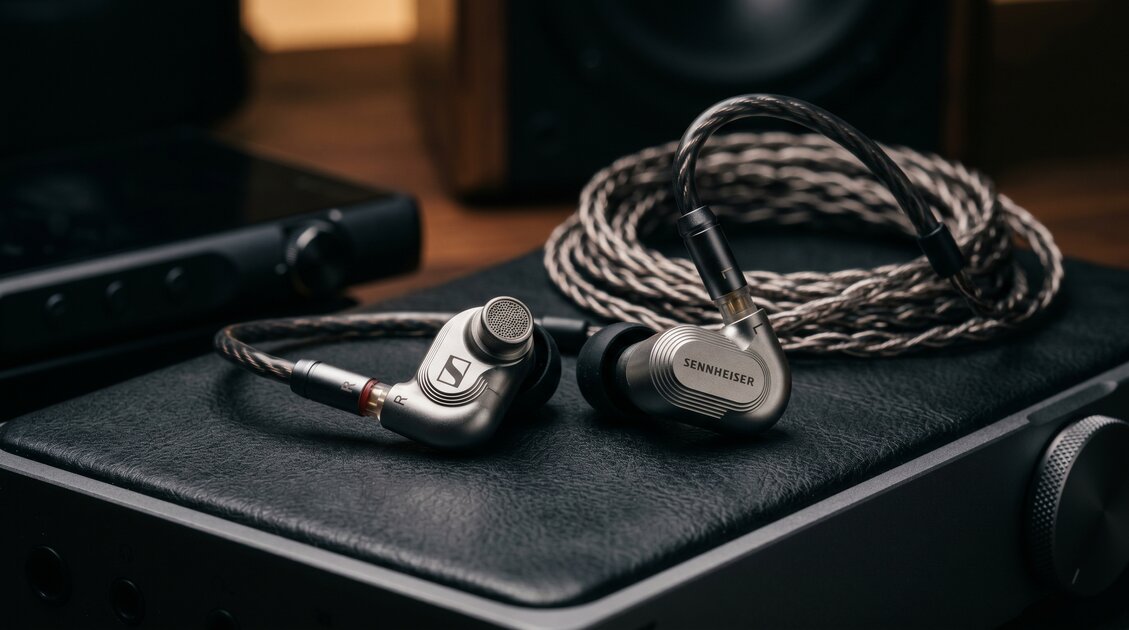
| Housing Material | Milled aluminum |
| Cable | Detachable Fidelity+ MMCX connectors |
The TrueResponse single dynamic driver is Sennheiser’s technical masterclass. By avoiding the phase-coherence challenges inherent in multi-driver crossovers (where the sound must be handed off from one driver to another), Sennheiser achieves a level of temporal accuracy that multi-driver IEMs struggle to match. The transducer’s rigidity and lightness, coupled with the internal Helmholtz-resonator acoustic chamber system (integrated into the aluminum housing), allow for an incredibly clean high-frequency extension without the metallic ringing or artificial sharpness that often plagues single-driver IEMs in the treble region.
Build and Design
The IE 900 is milled from a single block of aluminum. The build quality is exceptional—the housing is small, light, durable, and feels more premium than almost anything in its class. This is not a fragile piece of jewelry; it is a professional-grade monitoring tool built for daily use.
The cable system uses Sennheiser’s Fidelity+ MMCX connectors. They are recessed and designed for long-term reliability—a crucial improvement over the standard MMCX connectors that are infamous for degrading or becoming loose after constant unplugging. The ergonomics of the housing are well-shaped; they fit snugly in the ear canal and provide excellent isolation, which is critical for an IEM’s performance.
The included silicone and foam ear tips provide a secure fit and seal, which is essential for the bass response—the IE 900’s performance relies entirely on getting a perfect seal in the ear canal.
Sound Signature
Bass
The IE 900’s bass is one of its most surprising and rewarding qualities. Despite being a single dynamic driver IEM, it delivers sub-bass extension that reaches cleanly into the low 20s Hz with an authority that’s both visceral and controlled. Midbass punch is sharp and defined—kicks have attack, and decay is rapid, preventing any sense of muddiness even in dense electronic productions.
The Helmholtz-resonator system integrated into the aluminum shell specifically shapes the bass behavior, ensuring it is present, accurate, and physically impactful without dominating the overall frequency response.
Midrange
Natural, forward, and extraordinarily resolving. Because there is no crossover, the IE 900 avoids the phase-coherence issues that manifest as “smeared” transients or uneven vocal representation in multi-driver setups. Voices sound articulate and coherent, instruments are placed with pinpoint precision, and the overall balance of the midrange is exceptionally neutral.
If you are a listener who prioritizes vocal quality, instrument separation, and the ability to distinguish subtle variations in playing technique, the IE 900’s midrange transparency is its strongest attribute.
Treble
The IE 900’s treble is a showcase for the TrueResponse transducer’s capabilities. High-frequency extension is excellent, reaching cleanly into the ultrasonic range with a detail and clarity that feels effortless. What’s most notable is the lack of “artificiality”—the treble detail isn’t boosted or peaked; it’s simply there, revealed with the same resolution as the midrange and bass.
Cymbal strikes, high-frequency synth textures, and violin harmonics have an airiness and sparkle that feel naturally integrated into the rest of the frequency spectrum rather than “tacked on.” For those who are treble-sensitive, the IE 900 is technically revealing but rarely fatiguing, provided the recording itself isn’t aggressive in the high frequencies.
Soundstage and Imaging
The IE 900 provides a spatial presentation that feels remarkably open—a genuinely three-dimensional soundstage that is rare for an in-ear device. While it doesn’t achieve the scale of an open-back over-ear headphone, it creates a sense of space around instruments that makes the music feel like it’s unfolding in a real volume rather than just a left-right stereo separation.
Imaging precision is absolute. You can identify the lateral position of every instrument and, with well-recorded material, judge the distance of vocalists and instrument sections from the microphones.
Source Pairing and Practical Utility
The 16-ohm impedance and moderate sensitivity make the IE 900 an easy load for almost any source. It works flawlessly from a smartphone headphone adapter, a high-end portable DAC/amp like the iFi Go Blu, or a dedicated desktop source.
The IE 900’s transparency means it will reveal the noise floor or the sonic character of a mediocre source. If you use a noisy, low-quality dongle, the IE 900 will tell you about it immediately. Pair it with a high-quality portable DAC/amp to realize its potential.
Who Should Buy the IE 900?
- Listeners who prioritize technical resolution, temporal accuracy, and spatial imaging above all else
- Those who want flagship-level performance in a durable, tiny, portable package
- Listeners who prefer the coherence of a single, well-engineered dynamic driver over multi-driver crossover configurations
- Professionals who need an accurate, reliable reference tool for portable monitoring
- Audiophiles who prioritize a build-quality-for-the-ages experience
Who Should NOT Buy the IE 900?
- Those who want to “warm up” or color their music with their IEM—the IE 900 is relentlessly accurate
- Listeners for whom the ergonomic profile of the IE 900 (the specific shape of the housing) doesn’t fit—IEM comfort is personal
- Users on a budget—the IE 900 is a flagship investment
- Bassheads looking for artificial, boosted bass quantity over quality
Pros & Cons
Pros:
- Exceptional single-driver coherence—no crossover phase issues
- Benchmark technical resolution and spatial imaging in an IEM
- Visceral, extended, and controlled bass reproduction
- Durable, compact, and premium milled aluminum construction
- Fidelity+ MMCX connectors are a functional upgrade over standard MMCX
Cons:
- Premium price tier—it’s an expensive investment
- Relentlessly accurate—will reveal flaws in recordings and poor-quality source equipment
- Ergonomic profile is specific—fit is not guaranteed for every user
- No wireless/Bluetooth option
- Open-back performance is technically impressive but lacks the scale of over-ear designs
Frequently Asked Questions
Q: Does a single driver really beat multi-driver setups?
In terms of temporal coherence (the ability of a driver to play all frequencies simultaneously and accurately without phase shift), yes. Multi-driver IEMs offer flexibility in frequency response shaping (tuning individual drivers to behave differently), but they struggle with the phase issues that occur at the crossover frequencies. The IE 900 succeeds because Sennheiser engineered a single driver that covers the entire spectrum without compromise.
Q: Is the IE 900 comfortable for long sessions?
For users who get a good fit, yes. The housing is small and lightweight. If the ear tip selection is correct, the weight of the housing is essentially gone once it’s in the ear.
Conclusion
The Sennheiser IE 900 in 2026 remains a pinnacle of IEM engineering. While the market has moved toward increasing complexity—more drivers, more complex crossovers, exotic hybrid configurations—Sennheiser’s commitment to refining a single, coherent transducer has proven that performance is not a function of driver count. If you value technical performance, spatial imaging, and frequency coherence, the IE 900 is still the standard that high-end IEMs are measured against. It is an investment, yes, but one that rewards quality source material and amplification with a level of resolution that feels genuinely ultimate.