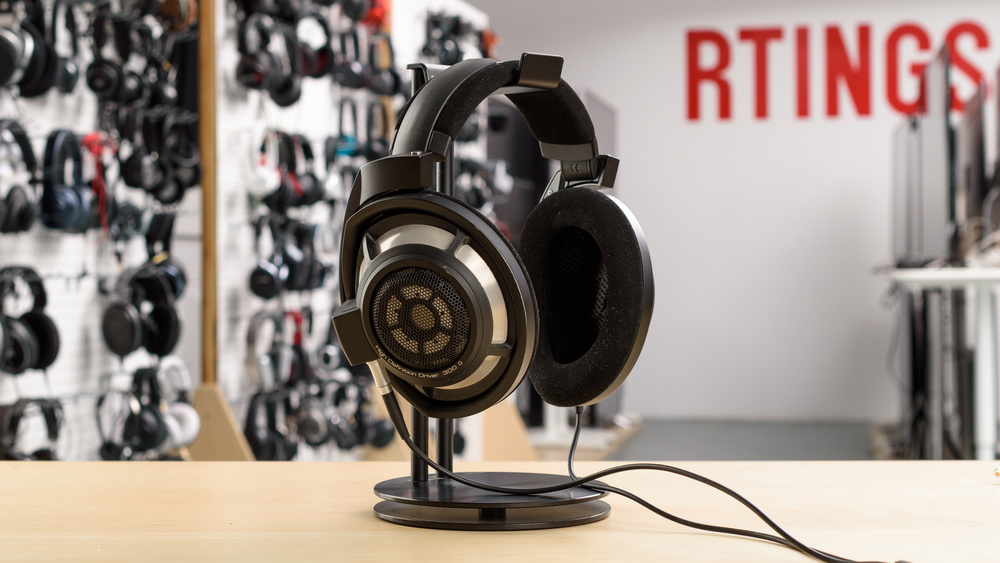
At the upper tier of dynamic driver headphones, two German manufacturers have spent decades building their respective cases for supremacy. Sennheiser’s HD 800S and Beyerdynamic’s T1 3rd Generation represent different answers to the same question: what does a flagship, open-back, dynamic driver headphone sound like when a company commits everything to the execution?
The answer, as it turns out, is dramatically different between the two—and the choice between them hinges on fundamental questions about what you want from a high-end listening experience.
Specifications
| Spec | Sennheiser HD 800S | Beyerdynamic T1 3rd Gen |
|---|---|---|
| Driver Type | Dynamic, open-back, 56mm ring radiator | Dynamic, open-back, 45mm Tesla driver |
| Impedance | 300 Ω | 32 Ω |
| Sensitivity | 102 dB SPL / 1V RMS | 100 dB SPL / 1V RMS |
| Frequency Response | 4 – 51,000 Hz | 5 – 50,000 Hz |
| THD | < 0.02% | < 0.05% |
| Weight | 330 g | 360 g |
The impedance difference here is enormous and has significant practical implications. The HD 800S at 300 ohms is firmly a desktop-only headphone that requires a capable amplifier with genuine voltage swing. The T1 3rd Gen at 32 ohms is considerably more flexible—it can be driven adequately from portable sources and sounds good even from modest desktop amplifiers, though it still scales with better equipment.
Sennheiser’s 56mm ring radiator driver is one of the largest dynamic drivers in any commercial headphone. This unusual ring-shaped design (the center of the driver is hollow) reduces distortion at resonance and contributes significantly to the HD 800S’s extraordinary soundstage performance. The T1’s Tesla driver technology uses extremely powerful neodymium magnets to achieve high efficiency and low distortion with a smaller driver footprint.
Design and Build
Sennheiser HD 800S
The Sennheiser HD 800S is enormous—the ear cups are massive and project well beyond the face. This size is functional: the 56mm ring radiator driver needs physical space to work, and the large ear cavity contributes to the headphone’s sense of acoustic distance and spaciousness. Construction uses a combination of stainless steel, microfleece, and high-quality plastic. The result is visually striking and feels appropriately premium for the price, though it’s not as weighty and solid-feeling as some competitors.
The microfiber ear pads are comfortable and breathable, critical for the long sessions this headphone invites. The headband distributes the 330g weight well, though the sheer size of the cups means the HD 800S is not a discreet-looking headphone.
The absorber system incorporated into the HD 800S (a small, tuned resonator integrated into the cup structure) was specifically designed to address the treble resonance peak that made the original HD 800 controversial. This resonator absorbs energy around 6 kHz, noticeably taming what was previously described as the “HD 800 treble peak.”
Beyerdynamic T1 3rd Gen
The Beyerdynamic T1 3rd Gen is a physically smaller headphone with a more conventional presentation. Beyerdynamic uses a metal yoke system with genuine aluminum and steel construction throughout, giving the T1 a more solid, reassuring feel in the hand. At 360g it’s slightly heavier than the HD 800S, but the weight distribution is well-managed.
The earcups use angled velour pads that provide good comfort and a semi-open acoustic window through the back of the cup. Beyerdynamic’s manufacturing heritage means the T1 3rd Gen is extensively built in-house, and the quality consistency is high.
The T1 3rd Gen includes a detachable mini-XLR cable system—a significant improvement over earlier T1 generations that used a fixed cable—along with both 3.5mm and 6.35mm output options via included adapters.
Sound Signature: HD 800S
The HD 800S is one of the most technically accomplished dynamic headphones ever produced, and its defining character trait is soundstage. No other headphone in this price class—and few at any price—presents a stereo image as wide, spatially coherent, and three-dimensionally convincing as the HD 800S.
Bass: The HD 800S does not emphasize bass. It is present, accurate, and well-extended, but it will never satisfy anyone seeking warmth or weight in the low frequencies. Below 40 Hz, the HD 800S rolls off gracefully. The bass that is present is extraordinarily controlled and textured—you hear the character of bass instruments precisely, without bloom or warmth.
Midrange: Transparent and detailed, with a slight thinness that some listeners associate with its analytical character. Voices are rendered with exceptional clarity, though they may occasionally feel slightly distant compared to headphones tuned with more presence-region emphasis.
Treble: Extended and detailed, with the absorbed 6 kHz peak considerably less problematic than the original HD 800. However, the HD 800S still has a forward, energetic treble that rewards high-quality recordings and can occasionally expose compression artifacts or harshness in poorly mastered material. This is not a forgiving headphone.
Soundstage: The primary reason people buy the HD 800S. The spatial presentation is genuinely unlike anything else—classical recordings in particular sound like you’re seated in the hall, with instrument positions precisely mapped across a wide, deep three-dimensional image.
Sound Signature: T1 3rd Gen
The T1 3rd Gen represents Beyerdynamic’s most refined expression of their house sound philosophy: warm, engaging, and musical rather than clinical and analytical.
Bass: Notably fuller than the HD 800S, with a warm midbass presence that gives music weight and body. The T1 doesn’t emphasize sub-bass dramatically, but the midbass warmth lends the overall presentation an organic, non-sterile character. Rock, jazz, and acoustic music benefit substantially from this treatment.
Midrange: Rich and forward, with a natural warmth that feels organic rather than colored. Vocals feel close and present. The T1’s midrange is arguably more musically engaging than the HD 800S for long listening sessions, even if it’s slightly less analytically precise.
Treble: Smooth and well-extended, without the HD 800S’s analytical brightness. The T1 3rd Gen addressed the treble issues that plagued earlier T1 generations (the 1st and 2nd gen T1 were notoriously bright with significant 8–10 kHz peaks). The 3rd gen tuning is considerably more refined and fatigue-free.
Soundstage: Smaller than the HD 800S—this is not a contest. The T1 provides a more intimate, enveloping presentation: music feels closer, more personal, like a small club performance versus a concert hall. This is a preference, not a flaw.
Amplification Notes
The Sennheiser HD 800S at 300 ohms is unambiguously a desktop headphone. It needs quality amplification—both sufficient current delivery and a quiet noise floor are essential. High-output-impedance amplifiers (which were common in vintage tube gear) will interact poorly with the HD 800S’s impedance curve and affect frequency response. Aim for an output impedance below 10 ohms, and ideally below 5 ohms.
The HD 800S also benefits significantly from balanced amplification, which reduces crosstalk and noise in a way that’s genuinely audible given the headphone’s exceptional spatial resolution.
The Beyerdynamic T1 3rd Gen at 32 ohms is considerably more flexible. Its warmer voicing pairs naturally with tube amplifiers and hybrid designs—the T1’s somewhat intimate soundstage and rich warmth complement the organic character of good tube output without the analytical precision of the HD 800S making amplifier colorations more audible. Solid-state amplifiers work well too, particularly neutral designs that let the T1’s inherent warmth speak for itself.
Both headphones benefit from premium sources. Check our Best Headphone Amps Under $1000 list for options that pair well with either.
Who Should Buy the HD 800S?
- Classical, jazz, and acoustic music listeners who want the most spatially convincing presentation available
- Mixing engineers or critical listeners who prioritize absolute resolution and technical accuracy
- Those with a high-quality desktop chain who want the headphone to reveal what that chain can do
- Anyone who finds “warm” or “intimate” headphone presentations unsatisfying
- Listeners whose music is consistently well-mastered and can withstand analytical scrutiny
Who Should Buy the T1 3rd Gen?
- Rock, jazz, pop, and classical listeners who want engagement over clinical analysis
- Anyone who values musical warmth and vocal presence over spatial extremes
- Those who want flexibility across both desktop and better portable sources (32 Ω)
- Listeners who prefer long sessions without treble fatigue
- Tube amplifier owners who want a headphone that pairs naturally with their setup
Who Should Buy Neither?
- Budget-constrained listeners for whom the price of either represents a significant stretch—there are excellent headphones at lower price points
- Bassheads expecting physical sub-bass impact
- Those who primarily listen to compressed streaming music without lossless sources
Pros & Cons
HD 800S
Pros:
- Unmatched soundstage in its class—genuinely holographic
- Extraordinary resolution and micro-detail retrieval
- Very low distortion (< 0.02% THD)
- The absorber system makes it far more listenable than the original HD 800
- Excellent build quality with premium materials
Cons:
- Brutally revealing of poor recordings and mediocre source equipment
- Expensive—requires additional investment in quality amplification to justify
- The analytical, thin character won’t appeal to listeners wanting warmth
- 300 ohms limits source flexibility entirely to desktop use
T1 3rd Gen
Pros:
- Warm, musical tuning that works beautifully with a wide range of genres
- 32 ohms provides genuine source flexibility
- The 3rd gen treble refinement eliminates the notorious brightness of earlier T1 versions
- Excellent build quality with in-house German manufacturing
- Detachable cable system (unlike earlier T1 generations)
Cons:
- Soundstage clearly smaller than the HD 800S
- Less analytically revealing—not ideal for critical mixing/mastering work
- Less technically precise at the top tier of resolution compared to the HD 800S
Frequently Asked Questions
Q: Can I run the HD 800S from a portable DAC/amp?
Technically yes, but practically not well. The HD 800S at 300 ohms requires voltage swing that most portable devices can’t provide without distortion at reasonable listening volumes. High-quality portable DAC/amps like the Chord Mojo 2 can drive the HD 800S adequately, but the headphone’s full technical capability only emerges with desktop-grade amplification.
Q: Is the T1 3rd Gen a significant improvement over the T1 2nd Gen?
Yes, meaningfully so. The 2nd gen T1 had a pronounced treble peak around 8–10 kHz that made long listening sessions uncomfortable for many listeners. The 3rd gen retuning addresses this significantly. If you found the original T1 series too bright, the 3rd gen is worth reconsidering.
Q: Which headphone benefits more from EQ?
The HD 800S is notoriously EQ-friendly—its bass can be boosted without audible distortion due to the ring radiator’s low harmonic distortion profile, and many listeners run a moderate bass shelf and a slight dip at the treble peak. The T1 is already closer to many listeners’ preference targets without EQ.
Conclusion
The HD 800S and T1 3rd Gen are both exceptional headphones that demonstrate what German engineering can achieve when the goal is long-term quality rather than mass-market appeal. They are not interchangeable—the HD 800S is a precision instrument for listeners who want to hear as deep into a recording as physics allows, with a soundstage that has no practical competitors at its price point. The T1 3rd Gen is a musical companion for listeners who want their flagship headphone to be engaging, warm, and genuinely enjoyable to live with every day.
Which is right for you is a question only your ears and your music library can answer—but both are worthy destinations for anyone serious about personal audio.