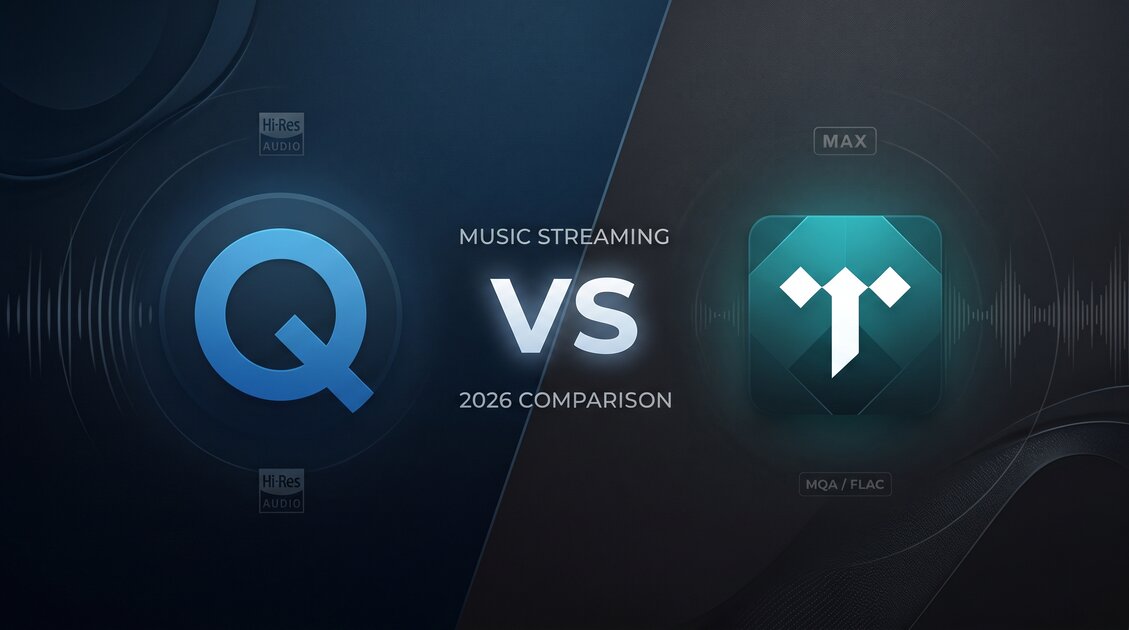
For nearly a decade, the high-fidelity streaming market has been a two-horse race. On one side sits Qobuz — the French purist that delivers genuine lossless FLAC and uncompressed CD-quality streams. On the other sits Tidal — the larger, more mainstream service that pioneered the Hi-Fi streaming category and now operates under Block (Square) ownership.
Both services now offer hi-res audio. Both run on virtually every device. Both cost around the same monthly fee. So which one deserves your subscription in 2026?
This comparison covers the real differences — audio quality, catalog depth, pricing, app experience, and the hard tradeoffs each service forces — to help you decide.
Audio Quality: The Core Difference
This is the most important section for anyone reading an audio-focused site. Let’s get the technical details right.
Qobuz: Bit-Perfect FLAC
Qobuz streams native FLAC at every tier. There is no wrapper format, no reconstruction step, no proprietary decoding. Your DAC receives the exact file the label delivered.
- Studio Premier tier: Up to 24-bit / 192 kHz FLAC
- Studio Sublime tier: Same hi-res FLAC, with discounts on music purchases
- Format: Native FLAC, no lossy conversion, no MQA
- Bit-perfect output: Yes, with compatible hardware
Qobuz was an early opponent of MQA (Master Quality Authenticated) — the controversial format that Tidal pushed heavily from 2017 onward. Qobuz argued — correctly, as it turned out — that native FLAC was superior to a folded, lossy-once-decoded format that required specific hardware to unfold the final “rendering” stage. By 2025, MQA’s decline was well-documented, and Tidal itself began backing away from the format in favor of FLAC.
In 2026, this matters because Qobuz simply delivers the raw file. There is no format-induced coloration, no “authentication” LED to chase. The music arrives as the master — period.
Tidal: The Post-MQA Transition
Tidal’s audio journey has been the messier of the two:
- Tidal HiFi (standard): 16-bit / 44.1 kHz FLAC (£10.99 / month)
- Tidal HiFi Plus: Up to 24-bit / 192 kHz FLAC (£19.99 / month)
- Legacy MQA tracks: Still present in the catalog, being phased out
- Dolby Atmos Music: Available on select tracks, up to 9.1.4 channels
Tidal’s migration from MQA to native FLAC has been gradual and incomplete. Many older “Master” tracks remain in MQA format, which means non-MQA DACs receive the 24-bit / 48 kHz “core” decode but miss the unfolded high-frequency extension. The result is inconsistent: some tracks sound genuinely hi-res; others sound slightly rolled off compared to a pure FLAC stream of the same master.
Tidal’s advantage is Dolby Atmos Music — an immersive spatial audio format that Qobuz does not support. If your system includes height channels or you use Apple’s spatial audio rendering in AirPods, Tidal’s Atmos catalog (roughly 100,000+ tracks) is a genuine differentiator.
Bottom line on audio fidelity: For pure stereo hi-res listening, Qobuz delivers cleaner, more consistent bit-perfect FLAC. For spatial audio and Atmos, Tidal is the only choice.
Catalog Size and Exclusives
Tidal’s Depth
Tidal’s catalog is larger, period. Roughly 110 million tracks compared to Qobuz’s 80–100 million, depending on regional availability. Tidal’s scale advantage comes from its earlier entry into the streaming market and its ownership by Block, which provides the resources for aggressive licensing.
Tidal also leans into curated exclusives:
- Tidal Rising: Emerging artist spotlights
- Tidal X: Concert streams and artist events
- Artist-owned content: Tidal’s ownership structure allows direct deals with major labels
Qobuz’s Editorial Curation
Qobuz has fewer tracks but compensates with arguably the best editorial curation of any streaming service. The Qobuzissime program — a seal awarded to exceptional new albums — is genuinely influential in audiophile and jazz circles. Their editorial team writes long-form reviews and listening guides that treat music as art, not algorithmic content.
Qobuz Magazine and the accompanying editorial section within the app is a real differentiator for listeners who value context and discovery through human recommendation rather than opaque algorithms.
Qobuz also excels in classical and jazz catalog depth. Niche labels that Tidal may carry only a fraction of — ECM, Hyperion, BIS, Alpha Classics — are represented comprehensively on Qobuz.
The catalog verdict: Tidal wins on sheer volume. Qobuz wins on editorial quality and classical/jazz depth.
Pricing Tiers: What You Actually Pay
One important note before we dive into numbers: Qobuz officially entered the UK market several years ago, which means UK pricing is direct in GBP with no VAT surprises.
Qobuz UK Pricing (2026)
| Plan | Monthly | Key Features |
|---|---|---|
| Studio Premier | £14.99/mo | Up to 24-bit/192 kHz FLAC, offline downloads |
| Studio Sublime | £24.99/mo or £179.99/yr | Same hi-res FLAC + up to 60% off hi-res purchases on Qobuz store |
Tidal UK Pricing (2026)
| Plan | Monthly | Key Features |
|---|---|---|
| HiFi (standard) | £10.99/mo | 16-bit/44.1 kHz FLAC |
| HiFi Plus | £19.99/mo | Up to 24-bit/192 kHz FLAC, Dolby Atmos, direct artist payouts |
The pricing gap between the two hi-res tiers is substantial. Qobuz Studio Premier (£14.99) undercuts Tidal HiFi Plus (£19.99) by £5 per month — a saving of £60 per year. That’s not pocket change.
Qobuz’s Studio Sublime tier adds significant value if you purchase music. The 60% discount on hi-res album purchases can easily justify the premium over the standard plan. If you buy, say, 4–5 hi-res albums per year at ~£18 each, you’re saving £40–50 on purchases alone.
Compare current Qobuz UK plans and pricing here →
Offline Playback
Both services support offline downloads, but the implementation differs meaningfully.
Qobuz allows downloads at the same bitrate you stream — hi-res FLAC stays hi-res on your device. Downloads are stored as standard FLAC files and can be transferred to other devices if you’re logged into your Qobuz account. Download limits are generous: you can store up to 50,000 tracks across up to 5 devices.
Tidal also supports hi-res offline downloads on the HiFi Plus tier, but the experience is less transparent. MQA tracks download in their compressed folded format and require the Tidal app for proper unfolding during playback. If you’re listening on a phone via USB to an external DAC, the full MQA unfolding chain must be active for optimal quality.
Practically speaking: Qobuz downloads are simpler to manage and maintain fidelity more reliably.
Desktop and Mobile Apps
Qobuz App
Qobuz’s desktop app (Windows / macOS) has improved significantly over the last two years but still lags behind Tidal in visual polish. The interface is functional, music-focused, and relatively clean. Key features:
- Exclusive/bit-perfect mode: Works reliably with most USB DACs
- Gapless playback: Supported, works well in most conditions
- Crossfade: Not available
- Connect: Qobuz Connect (streaming to compatible devices) is functional but limited compared to Tidal Connect
The mobile app (iOS / Android) is competent if uninspiring. Navigation is clear; search works well; the download management is straightforward. Qobuz lags in one significant area: smart playlists and algorithmic discovery are far behind Tidal and Spotify.
Tidal App
Tidal’s app is slicker and more modern. The 2025 redesign brought:
- Tidal Connect: Stream to hundreds of compatible devices (DACs, streamers, smart speakers) — significantly broader than Qobuz Connect
- Smart playlists: “My Mix” daily mixes are genuinely useful for discovery
- Music videos: Tidal has a large catalog of music videos and live session recordings
- Better algorithm: Tidal’s recommendation engine has consistently improved
Tidal’s mobile app wins on polish. The search, playlist management, and “Track Radio” feature (generating a playlist from a single track) feel more refined than the equivalent Qobuz features.
However, neither app is perfect. Both suffer from occasional library management quirks — albums splitting into singles, incorrect metadata, and the usual streaming service clutter.
Exclusive Content and Extras
Tidal’s unique offerings:
- Tidal X: Livestreamed concerts and events
- Dolby Atmos Music: Significant and growing catalog
- 360 Reality Audio: Legacy format, still available but not heavily promoted
- Direct artist payouts: HiFi Plus subscribers send a larger share to the artists they listen to most
- Music videos and interviews: Extensive catalog
Qobuz’s unique offerings:
- Qobuz Magazine: In-depth reviews, artist interviews, listening guides
- Hi-res music store: Buy individual albums at discounts up to 60% on Sublime
- Qobuzissime: Curated seal of excellence for outstanding new releases
- Better metadata: Album credits, recording details, engineer info preserved more reliably
For the serious listener who values context and music journalism, Qobuz’s editorial approach is unmatched. For the casual listener who wants videos, spatial audio, and artist connection, Tidal offers more.
Verdict: Which Should You Choose?
Choose Qobuz if:
- Audio quality is your top priority. True, native FLAC with no format compromises. If you’ve invested in a good DAC and want bit-perfect delivery, Qobuz is the honest choice.
- You listen primarily to stereo music. Classical, jazz, acoustic, and well-recorded rock benefit from transparent, uncompressed delivery.
- You value editorial context. The Qobuzissime program and Qobuz Magazine genuinely enhance discovery for curious listeners.
- You want better value. Studio Premier at £14.99 delivers the same (or better) audio quality as Tidal HiFi Plus at £19.99 — saving you £60/year.
- You purchase music. Studio Sublime’s purchase discounts make it the best deal in hi-res streaming if you also buy albums.
Check the latest Qobuz UK plans and start your free trial →
Choose Tidal if:
- Catalog size matters. Tidal’s ~110M tracks regularly edges ahead on new releases and niche genres.
- You have a multi-channel or Atmos system. Dolby Atmos Music is a genuine experience Tidal delivers and Qobuz doesn’t.
- App polish and discovery matter. Tidal’s UI, recommendations, and Tidal Connect ecosystem are more mature.
- You want music videos and live events. Tidal’s video catalog is substantial and well-curated.
Summary
| Feature | Qobuz | Tidal |
|---|---|---|
| Hi-res format | Native FLAC (24/192) | FLAC + legacy MQA |
| Hi-res monthly price | £14.99 | £19.99 |
| Catalog size | ~80–100M | ~110M |
| Dolby Atmos | ✗ | ✓ |
| Offline hi-res downloads | ✓ (straight FLAC) | ✓ (MQA folded) |
| Desktop app quality | Good | Better |
| Mobile app quality | Good | Better |
| Classical/jazz depth | Excellent | Good |
| Editorial curation | Best in class | Average |
| Music purchase discounts | ✓ (Sublime) | ✗ |
The honest answer: in 2026, the streaming format wars are largely settled. MQA is on its way out. Both services can deliver excellent sound quality. The remaining differences come down to priorities.
Qobuz wins for the audiophile who wants genuine, unprocessed hi-res FLAC without paying a premium for it. Tidal wins for the listener who values a polished app experience, a broader catalog, and the unique appeal of Atmos spatial audio.
There is no wrong choice here — but for my money, Qobuz gets the fundamentals right, and at a better price.