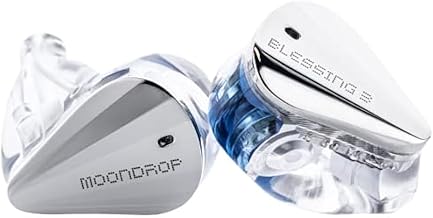
The IEM market in 2026 is more crowded than it has ever been, with Chinese manufacturers flooding every price bracket with competent contenders. Despite that, when you ask any serious in-ear enthusiast to name the single best IEM under $500, the answer is almost always the same: the Moondrop Blessing 3. That near-universal consensus is not the product of hype — it’s the product of a genuinely exceptional piece of engineering that gets almost everything right.
This review covers why the Blessing 3 has remained the benchmark in its class, who should buy it, who should look elsewhere, and what you need to drive it properly.
Specifications
- Driver configuration: 1 dynamic driver (DD) + 4 balanced armatures (BA), 1DD+4BA hybrid
- Impedance: 22Ω
- Sensitivity: 122 dB/Vrms
- Frequency response: 5Hz – 40,000Hz
- Cable: 2-pin 0.78mm detachable
- Shell material: Resin + CNC aluminum faceplate
The hybrid driver configuration is what makes the Blessing 3 tick. Moondrop uses a single 10mm dynamic driver to handle the bass and sub-bass, where dynamic drivers excel thanks to their natural air-moving capability, and then delegates the mids, upper mids, and highs to the four balanced armature drivers. This division of labor avoids the typical hybrid pitfall of crossover phase issues — the Blessing 3 is notably coherent from bass to treble, with no audible seam between the drivers.
Sound Signature
The Blessing 3 follows a neutral-bright tuning that is heavily influenced by the Harman 2019 IEM target with a slight upper-midrange lift. It is not warm, it is not V-shaped, and it is emphatically not “fun-tuned” in the consumer sense. It is tuned for accuracy and detail retrieval. If you’re coming from something like a Beats or Bose earphone, this will initially sound lean. Give it time. What you’re hearing is the music itself, uncolored.
Bass
The bass is handled by the dynamic driver, and it shows. Sub-bass extension is excellent — it reaches down into the 20–30Hz range with authority, and when a track has real sub-bass energy, you feel it. The midbass is controlled and well-defined, with no bloom or bloat. Bass guitar notes have texture and leading-edge definition that cheaper IEMs simply smear. If you primarily listen to EDM, hip-hop, or bass-heavy music and want maximum warmth and thump, this won’t satisfy you. For those who want accurate bass with impact when the recording calls for it, the Blessing 3 delivers exactly that.
Midrange
This is where the Blessing 3 distinguishes itself from most of its competition. The midrange is open, forward, and exceptionally clear. Male and female vocals sit at the right presence level — neither recessed (as they are in many V-shaped IEMs) nor over-bright and sibilant. Acoustic guitar, piano, and strings all have a natural tonal character. The upper midrange around 3–4kHz has a slight elevation that keeps the presentation airy and detailed, but it stops short of becoming fatiguing on most well-recorded tracks.
Treble
The treble is extended and well-articulated. Cymbal hits have realistic shimmer, and high-hat transients are crisp without being sharp or piercing. There is a mild peak around 8kHz that can occasionally make certain recordings feel slightly bright — if you are particularly treble-sensitive, this is worth knowing. For most listeners and most genres, the treble is a strength, not a weakness. Detail retrieval in the high frequencies outperforms essentially everything else in this price bracket.
Soundstage and Imaging
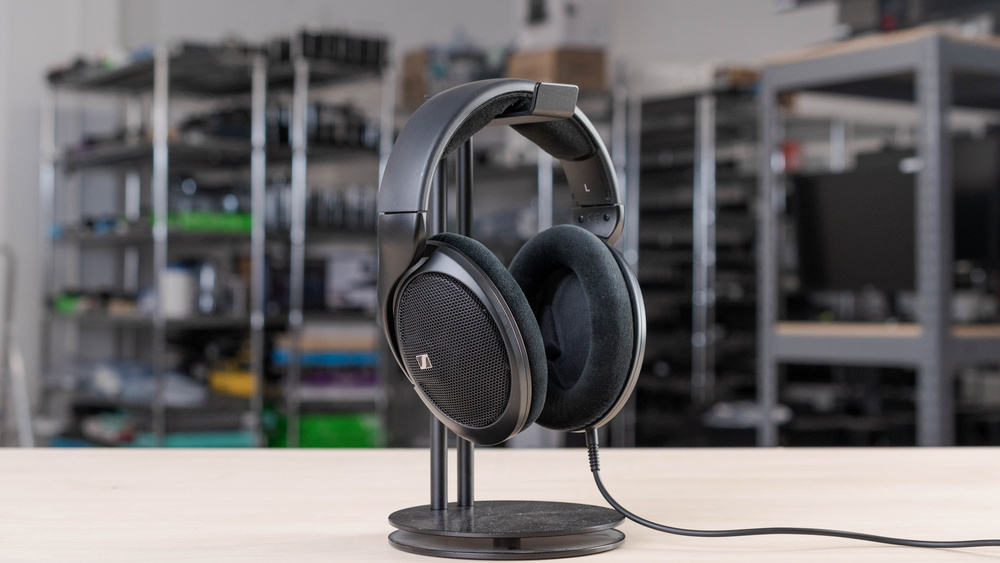
For an IEM, the Blessing 3 has a surprisingly wide and three-dimensional stage. It doesn’t sound like you’re listening in a box. Imaging — the ability to precisely locate instruments left, right, and center — is excellent and makes the Blessing 3 genuinely useful for critical listening of complex orchestral or jazz recordings. Compare it to the open, airy presentation of something like a Sennheiser HD 560S, and you’ll find that the Blessing 3 actually holds its own for spatial performance.
Build Quality and Comfort
The shell is a custom-style resin body with a CNC-machined aluminum faceplate. It’s light, smooth, and clearly well-finished. The fit uses a “universal custom” shape based on averaged ear canal measurements — for most people, it fits well out of the box, but if you have smaller ear canals, you may need to experiment with tip sizes. The stock tips are functional but not outstanding; a set of aftermarket tips (Spinfit CP145 or Final E-type) can improve both isolation and bass response.
The over-ear cable is braided and well-behaved — no memory wire issues, low microphonics. The 2-pin connector is secure without being stiff. This is not a $50 budget IEM where the cable falls apart in three months.
Source Pairing
At 22Ω and 122dB sensitivity, the Blessing 3 is technically easy to drive. A decent dongle DAC — the Moondrop Dawn Pro, the Apple USB-C dongle, or a Qudelix 5K — will give you full volume and good dynamics. However, like any resolving IEM, it scales with source quality. A clean 4.4mm balanced output will improve imaging width and separation noticeably over single-ended. If you’re using a dedicated DAP or a desktop stack, the Blessing 3 will reward you for the investment in the source.
Because it is sensitive (122dB), background noise from weaker DAC/amps can be audible in quiet passages — choose a DAC/amp with a low noise floor, not just one with enough output voltage.
Who Should Buy the Moondrop Blessing 3
Buy this if:
- You want the most technically accomplished IEM under $500
- You prioritize detail retrieval, accuracy, and a neutral tuning
- You’re a frequent traveler who wants to bring audiophile performance on the road
- You’re upgrading from something like a Moondrop Aria or Kato and want a significant jump in resolution
Skip this if:
- You want warm, bass-heavy, or fun-colored sound
- You have small ear canals and struggle to get a good seal (fit issues can ruin any IEM)
- You’re budget-constrained — the Moondrop Kato or Aria 2 offer 80% of this performance for significantly less money
- You find 8kHz peaks fatiguing (in which case the Moondrop S8 or Etymotic ER2SE might suit you better)
If you are used to the sound signature of the HiFiMAN Sundara or the analytical neutrality of the Beyerdynamic DT 990 Pro and want to take that sound philosophy portable — to the office, the gym, a plane — the Blessing 3 is the closest thing available.
Pros and Cons
Pros:
- Exceptional detail retrieval and resolution for the price
- Coherent hybrid tuning with no crossover coloration
- Good build quality with premium-looking faceplate
- Scales well with source quality
- Wide, three-dimensional soundstage for an IEM
Cons:
- Mild 8kHz peak may fatigue treble-sensitive listeners
- Stock tips are merely adequate — budget for an aftermarket set
- Not the right choice for listeners who prefer warm or bass-heavy sound
- Fit can be hit-or-miss for smaller ear canals
Frequently Asked Questions
Q: Does the Moondrop Blessing 3 need an amplifier? A: It doesn’t require one — it will play at full volume from most phones. But it will reward a better source. A balanced 4.4mm connection from a quality DAC/amp improves staging and separation meaningfully. Use at minimum a dedicated dongle DAC rather than a phone’s built-in output for best results.
Q: How does it compare to the Moondrop Blessing 2 Dusk? A: The Blessing 3 is a meaningful upgrade in resolution and coherence. The Dusk had a sub-bass shelf tuned with collaboration from Crinacle and was more fun-sounding; the Blessing 3 is more technically capable but less V-shaped. Which you prefer depends on your tuning preference.
Q: Is the Blessing 3 good for commuting and noise isolation? A: Yes — the resin shell and over-ear fit provide solid passive isolation that works well on public transit or in noisy offices. It’s not as isolating as a deep-insertion IEM like the Etymotic ER4, but it’s more than adequate for everyday use.
Conclusion
The Moondrop Blessing 3 earns its benchmark status honestly. In a market full of over-hyped “endgame” IEMs that underwhelm on close examination, this one actually delivers. It is technically accomplished, well-built, coherently tuned, and genuinely competitive against IEMs that cost significantly more. The caveat is clear: this is a monitor-style tuning, not an entertaining one, and if you want warmth and bass slam, look elsewhere. But for anyone chasing accuracy and resolution in a portable package, the Blessing 3 remains the standard against which everything else in its price range is measured.
For a broader look at the in-ear landscape, read Best Audiophile IEMs 2026.