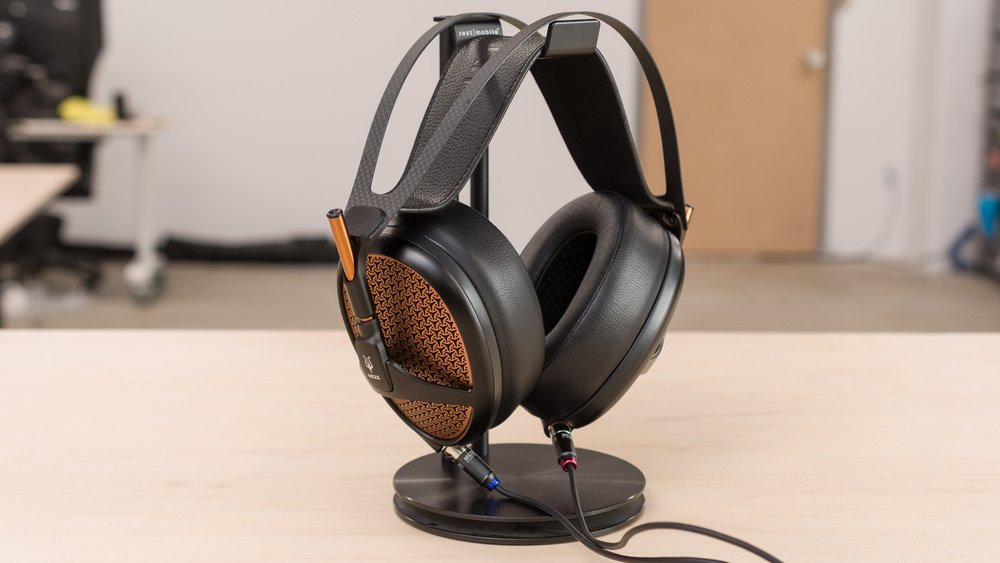

The Meze Empyrean III lands in a crowded segment—statement-level planar magnetic headphones at a price that requires genuine justification. At approximately $3,000–$3,500, it competes with Audeze’s LCD-4 series, HiFiMAN’s Susvara and Edition XS, ZMF’s wood-cupped flagships, and various other products that stake their claims on different combinations of technical performance, luxury materials, and brand identity.
What Meze offers with the Empyrean III specifically is their isodynamic hybrid array driver, a material approach to construction that emphasizes genuine luxury over cost-effective premium signaling, and a tuning philosophy that prioritizes long-session musicality over analytical precision. Whether those priorities align with yours determines whether the price is justified.
Specifications
| Spec | Value |
|---|---|
| Driver Type | Isodynamic hybrid array, planar magnetic |
| Impedance | 32 Ω |
| Sensitivity | 101 dB SPL / 1mW |
| Frequency Response | 4 Hz – 110 kHz |
| THD | < 0.1% at 100 dB |
| Weight | ~430 g |
| Cable | 3.5mm TRRS with 4-pin XLR adapter included |
The 32-ohm impedance and 101 dB/mW sensitivity make the Empyrean III one of the more source-flexible flagship headphones available. Unlike planar magnetics that require dedicated high-power desktop amplifiers, the Empyrean III can be driven adequately from high-quality portable sources. It still benefits from desktop amplification, but it doesn’t demand it as a prerequisite for reasonable performance.
The “isodynamic hybrid array” driver designation is Meze’s description of their approach to planar magnetic driver design: rather than using a single planar element with uniform trace geometry, the Empyrean’s driver uses different trace configurations in the high-frequency and low-frequency zones of the diaphragm. The outer portion is optimized for low-frequency response; the inner portion for high frequencies. The practical goal is to improve both bass extension and high-frequency coherence without the compromises that a single uniform trace pattern typically involves.
Design and Build
The Empyrean III’s physical presence is its most immediately distinctive attribute. Meze combines leather earcups, premium aluminum hardware, and genuine wood headband inserts in a package that communicates luxury through materials rather than excessive visual complexity. The aesthetic is restraint executed expensively—clean, considered, and coherent rather than ostentatious.
Earcup construction: The leather earcups are structured and visually rich. The leather is quality—not the compressed bonded material that lower-end products use, but genuine leather with texture, weight, and the kind of surface character that ages rather than degrades. The cup geometry is the characteristic Meze oval shape, allowing the driver to be positioned close to the ear without the circular format’s tendency to contact the ear in the wrong place.
Headband: The headband system uses machined aluminum for structural components with a wood insert and leather padding. The suspension adjustment mechanism distributes clamping force evenly, and the headband padding is substantial enough for extended sessions without creating pressure points. The Empyrean III made specific improvements to headband weight distribution over the II—the force is better spread laterally, reducing the sensation of the headphone’s weight concentrating at the crown of the head.
Earpads: Large, angled leather pads that provide good acoustic seal and consistent positioning. The leather runs warmer than velour alternatives during extended sessions, though the Empyrean III’s pad geometry mitigates heat buildup better than smaller pads with less breathing room. Meze sells replacement pads, and the pad system is straightforward to maintain.
Weight: At approximately 430g, the Empyrean III is lighter than Audeze’s heavy LCD flagships. The weight distribution is well-managed, and most listeners report comfortable sessions extending 2–3 hours without significant fatigue—a meaningful practical advantage over heavier competing products.
Sound Signature
Bass
The Empyrean III’s bass is smooth, controlled, and full. The hybrid array driver’s outer bass-optimized zone provides genuine low-frequency extension into the sub-bass region, while the inner trace configuration maintains control and definition. The result is bass that feels organic rather than analytical—present, weighty, and textured without the clinical precision of Audeze’s LCD-X tuning.
This is not bass-heavy headphone tuning. The low end is elevated relative to a neutral reference, but the emphasis is in the midbass warmth rather than sub-bass slam. Rock music gains body and weight; orchestral music gains physical presence in low brass and percussion; jazz bass has the richness that makes it sound like a recording rather than a reproduction.
Compared to the Empyrean II, the III’s bass is reportedly tighter and better controlled at extreme low-frequencies—the driver refinement reduces the slight low-frequency smearing that some reviewers noted in the previous generation.
Midrange
The midrange is where the Empyrean III’s character most clearly reflects its design priorities. The presentation is organic, smooth, and full—voices have natural warmth and presence, acoustic instruments have weight and texture, and the overall character is one of listening to music rather than analyzing it. There is nothing clinical or sterile in the Empyrean III’s midrange, and that’s a deliberate choice.
What you give up in exchange is the last degree of analytical precision. The Empyrean III is not the tool for identifying a 1 dB EQ adjustment in the presence region of a mix. It’s a headphone for sitting with a recording and letting it reveal itself gradually rather than interrogating it technically.
Treble
The treble refinement in the III relative to the II is the most discussed improvement in the revision. The previous Empyrean had a top end that some listeners found slightly prominent or “sizzly”—not harshly bright, but forward enough to be fatiguing on certain recordings in extended sessions. The Empyrean III’s revised driver topology addresses this: the treble is extended and detailed but smoother, with less energy in the 8–12 kHz region that previously caused occasional edginess.
The result is a treble that’s present and detailed without demanding attention. Cymbal detail is there; string harmonics extend naturally; but the listener doesn’t feel like the headphone is constantly presenting the high-frequency content at them. This makes long sessions considerably more comfortable than the previous generation, particularly on modern mastered recordings where the top end can already be energetic.
Soundstage
The Empyrean III presents a soundstage that’s wider than the intimate closed-back presentation but narrower than truly wide open-back designs like the HiFiMAN Arya or Sennheiser HD 800S. The semi-open nature of the cup design allows more acoustic freedom than a fully sealed closed-back headphone, and Meze has worked to create a presentation that doesn’t feel claustrophobic or congested.
Imaging precision is good—instruments are placed in the soundfield coherently and remain stable across complex passages. The depth of the soundstage (front-to-back layering) is a particular strength; the Empyrean III creates a sense of dimensional space that many headphones at this price level flatten into a more two-dimensional presentation.
Source Pairing
At 32 ohms and 101 dB/mW, the Empyrean III pairs with a broader range of sources than most flagship headphones. A high-quality portable DAC/amp (Chord Mojo 2, Sony NW-WM1AM2, iBasso DX240) drives it adequately. A quality desktop amplifier takes it further, improving bass control, dynamic range, and noise floor.
The Empyrean III’s character pairs well with amplifiers that prioritize resolution and low noise over added warmth. The headphone provides its own organic character; a very warm amplifier can push the overall presentation past the point of balance. Neutral solid-state amplification and high-quality DAC sources complement the headphone’s natural musicality without adding coloration on top of it.
Balanced connections (4-pin XLR via the included adapter) improve channel separation and noise floor in ways that are audible on quiet passages in complex recordings.
Who Should Buy the Empyrean III?
- Listeners who prioritize long-session musicality and comfort over clinical analytical precision
- Those who value genuine luxury materials and construction as part of the ownership experience
- Audiophiles in the upper price tier who want a planar magnetic alternative to Audeze’s heavier LCD flagships
- Listeners whose source chain is already high-quality and who want a headphone that benefits from that investment without demanding extreme amplification
- Classical, jazz, folk, and acoustic music listeners who want organic warmth and physical presence
Who Should NOT Buy the Empyrean III?
- Mixing and mastering engineers who need reference-neutral tuning—the Empyrean III’s organic character is a virtue for listening, not for mixing decisions
- Those who specifically want the widest possible soundstage—Arya Stealth or HD 800S are better choices for extreme staging. If you prefer a closed-back portable option, the Meze 99 Classics offers that same Meze build quality at a fraction of the price.
- Budget-conscious buyers for whom $3,000+ doesn’t represent a considered discretionary spend
- Listeners who want more analytical high-frequency detail and are willing to sacrifice warmth for it
Pros & Cons
Pros:
- Genuine luxury materials—leather, aluminum, and wood executed at a standard consistent with the price
- Improved treble smoothness over the Empyrean II; noticeably less fatiguing on energetic recordings
- Organic, musical midrange character that rewards long sessions
- Better headband weight distribution than the II; more comfortable for extended listening
- 32-ohm impedance provides unusual source flexibility for a flagship headphone
- Well-constructed, replaceable pads and cables for long-term ownership
Cons:
- At $3,000+, the price demands honest evaluation against what’s available for significantly less
- Organic, warmer character reduces utility for critical mixing/mastering reference work
- Leather earpads run warmer than velour alternatives during extended sessions
- Soundstage, while good, doesn’t match the scale of wide-staging open-back alternatives at this price
- The isodynamic driver refinement, while real, may not produce audible improvements for everyone upgrading from the II
Frequently Asked Questions
Q: Is the Empyrean III a meaningful upgrade over the Empyrean II?
The treble refinement is the most consistently noted improvement—the smoother top end makes a real difference in long-session comfort and is audible in direct comparison. The headband distribution improvement is also real and appreciated by anyone who found the II fatiguing over extended sessions. Whether these refinements justify the upgrade price from an owned II depends on how much the II’s treble bothered you. For first-time buyers in this tier, the III is simply the current and better version.
Q: How does the Empyrean III compare to the Audeze LCD-4 in this price range?
Different design philosophies. The LCD-4 is more analytically precise, with a more controlled and neutral frequency response suited to professional reference applications. The Empyrean III is more organic and musical, with a more comfortable physical design for long sessions. The LCD-4 will be preferred by those who want their headphone to tell the truth about recordings; the Empyrean III by those who want their headphone to make music enjoyable.
Q: Does the Empyrean III need a specific type of amplifier?
No single type, but it rewards quality. The low impedance makes it more flexible than typical flagships—it’s not an amplifier-destroying load. A neutral or slightly cool-measuring solid-state amplifier lets the Empyrean III’s own character speak. Very warm amplification can push the overall presentation too far toward density; very analytical amplification can make the headphone feel colder than its design intent suggests.
Conclusion
The Meze Empyrean III represents a specific and coherent product philosophy: flagship-level planar magnetic performance delivered through genuine luxury materials, in a form factor that prioritizes long-session comfort and organic musicality over clinical analytical precision. The driver refinements in the III are real—the treble improvement alone is worth noting for anyone who found the II’s top end occasionally demanding—and the physical execution maintains the standard that made the Empyrean line’s reputation.
It’s expensive as hell, and that’s worth saying directly. At $3,000+, you’re paying for a combination of acoustic engineering and material quality that few products provide simultaneously. What you’re not getting is the most analytically revealing headphone in its price range—that description belongs to competitors with different priorities. What you are getting is one of the most genuinely pleasurable headphones to spend long hours with, and at this price level, that’s a legitimate and defensible reason to buy.
About the Writer
Jack: Skeptical, wallet-watching, and strictly here for the gear.