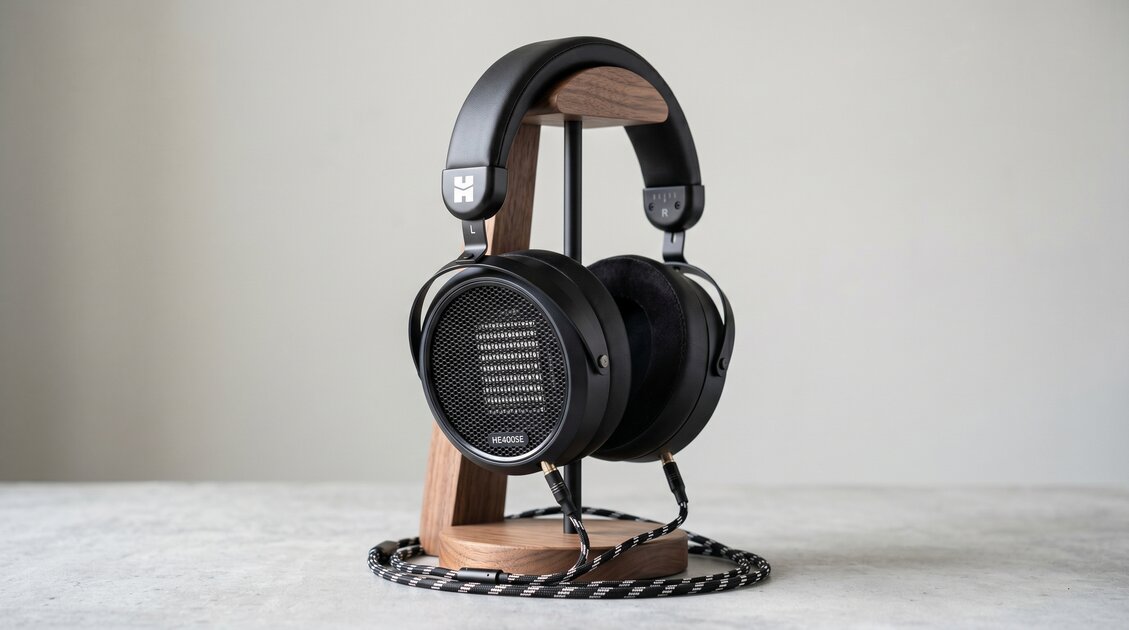
Getting someone to pay $150 for a headphone when Bluetooth earbuds exist is a hard sell. Getting someone to pay $150 for a headphone that outperforms many $500 products in a specific set of technical criteria — that’s a different conversation. The HiFiMAN HE400SE is the entry point into planar magnetic audio, a driver technology that was previously the exclusive domain of $500+ headphones. For 2026, it remains the best and essentially only option for exploring that technology at a genuinely accessible price.
This review explains what makes the HE400SE genuinely impressive, where it falls short, and who it’s actually designed for.
Specifications
- Driver type: Planar magnetic, stealth magnet array
- Impedance: 25Ω
- Sensitivity: 91 dB
- Frequency response: 20Hz – 20,000Hz
- Weight: ~440g
- Cable: 3.5mm dual 3.5mm jack (each cup), 1.5m
The “stealth magnet” designation refers to HiFiMAN’s design where the magnets holding the planar diaphragm are shaped to reduce acoustic diffraction. In practical terms, it contributes to a more uniform frequency response compared to earlier HiFiMAN designs that used rectangular magnets. The diaphragm itself is nanometer-thin — far lighter than any dynamic driver cone — and this low mass is the fundamental reason planar headphones are known for their transient speed.
What Is a Planar Magnetic Driver?
The question is worth answering properly, because it’s central to understanding why the HE400SE sounds the way it does.
A conventional dynamic driver works like a small loudspeaker: a voice coil is attached to a cone or dome, current through the coil interacts with a magnet, and the coil moves the cone. The drive force is concentrated at the coil attachment point, which can introduce resonance and distortion in the rest of the cone.
A planar magnetic driver replaces the cone with an ultra-thin membrane with conductive traces distributed across its entire surface. Magnets on both sides of the membrane interact with these traces uniformly across the whole surface, meaning every part of the diaphragm moves together. The result: lower distortion, more consistent pistonic motion, faster transients, and a uniquely textured, controlled bass that doesn’t bloom or lose definition at high volumes.
This technology was expensive to manufacture for decades. The HE400SE is a product of that manufacturing cost finally being driven down to a point where it’s accessible.
Sound Signature
The HE400SE is tuned broadly neutral with a slight warmth in the lower midrange. It is not a bass-boosted consumer headphone, and it’s not aggressively bright. It sits in a pleasantly balanced zone that makes it widely enjoyable without being obviously colored.
Bass
Planar bass at this price point is the HE400SE’s single greatest selling point. The sub-bass extension is genuine — reaching down below 30Hz with real energy, not just measurement-flattering roll-off that you can’t actually hear. More importantly, the quality of that bass is distinctively different from budget dynamic headphones: it’s tight, defined, and textured. A low synth pad has distinct pitch identity. Kick drums have a precise attack with clean decay. The bass doesn’t bloom or thicken the mix the way warmer dynamic headphones do.
This doesn’t mean the HE400SE has emphasized bass — the quantity is moderate. The distinction is in the quality and control. Compared to the Beyerdynamic DT 990 Pro, the HE400SE’s bass is leaner but more defined. For listeners who prioritize texture over impact, this is a strength.
Midrange
The midrange is clear and open. Vocals sit at a reasonable presence level — not recessed as they are in heavily V-shaped headphones, not unnaturally forward either. Acoustic instruments have a natural tonal body. Piano notes have correct weight. The HE400SE avoids the hollow or thin midrange character that sometimes appears in planar designs with less sophisticated crossover engineering. There’s a natural, if slightly smooth, quality to the midrange reproduction that makes it easy to listen to for extended periods.
Treble
The treble on the HE400SE is present but not aggressive. There are no sharp peaks that cause immediate fatigue, and the high-frequency extension is adequate — cymbal shimmer and string overtones are rendered clearly without being piercing. This is a relatively safe treble tuning that trades some sparkle and air for comfort and accessibility. Treble-sensitive listeners will appreciate this. Those who want maximum detail retrieval in the high frequencies may find the HE400SE slightly soft up top.
Soundstage and Imaging
The soundstage is notably wide for a $150 headphone — wider than most dynamic headphone options at this price point. The open-back design allows air to move freely, and the planar driver’s low distortion contributes to a cleaner, more uncluttered spatial presentation. Imaging is good — instrument placement is consistent and stable, though not quite as precise as the better-tuned options in the $300+ bracket.
Build Quality and Comfort
This is the area where HiFiMAN’s cost-cutting is most visible, and where honest reviews have to be direct. The HE400SE is not a beautifully built headphone. The headband is a basic headphone-strap design — similar to what you’d find on a cheap DJ headphone — and there’s no self-adjusting mechanism. Getting the right fit requires manual adjustment of the slider, and the plastic housing feels lightweight in a way that doesn’t inspire confidence about longevity.
The pads are a pleather-on-the-outside, fabric-on-the-inside hybrid design that is comfortable for most sessions but will eventually compress and require replacement. Aftermarket pad options are available and can meaningfully change the sound signature.
The weight is the most tangible build concern: at ~440g, the HE400SE is heavy for a budget headphone. The basic headband does little to distribute this weight, which can cause fatigue on longer sessions unless you find the right positioning. This is a known trade-off of planar magnetic drivers — the magnet arrays add mass that dynamic drivers don’t have.
The cable is a low-cost dual 3.5mm affair that terminates in 3.5mm single-ended. It works, but it feels cheap. Third-party replacement cables are widely available.
Source Pairing
At 25Ω and 91dB sensitivity, the HE400SE actually demands more driving ability than the specs might suggest. The 91dB sensitivity is low — most phones will reach acceptable volume but will clip or strain at high volumes. A good dongle DAC (FiiO KA3, Qudelix 5K, or Apple USB-C dongle minimum) makes a meaningful difference. A budget desktop amp like the FiiO K5 Pro ESS or Schiit Magni Heresy will provide the full bass authority and dynamic range the planar driver is capable of.
Don’t let under-driving be the reason you’re disappointed. The HE400SE straight out of a laptop headphone jack often sounds uninspiring. From a proper source, it’s a genuinely different — and much better — experience.
Who Should Buy the HiFiMAN HE400SE
Buy this if:
- You’re curious about planar magnetic audio and want to try the technology without spending $300+
- You value bass texture and control over bass quantity or impact
- You’re comfortable adding a budget DAC/amp to your setup
- You listen primarily to acoustic music, jazz, rock, or electronic where fast transients matter
Skip this if:
- You want warm, fun-sounding, or bass-heavy presentation — this is not that
- Build quality and durability are primary concerns — invest in a Sennheiser or Beyerdynamic for that
- You plan to drive it from a phone without a DAC/amp — you’ll be under-driving it
- You want to take it portable — at 440g, it’s not practical for commuting
When you’re ready to step up from here, read our HiFiMAN Sundara Review 2026 for a comprehensive look at the next tier.
Pros and Cons
Pros:
- Entry point into genuine planar magnetic audio for ~$150
- Outstanding bass quality and texture for the price
- Wide, open soundstage courtesy of the planar driver and open-back design
- Neutral tuning that doesn’t impose a coloration on the music
- Scales noticeably with better amplification
Cons:
- Build quality is functional but uninspiring — feels lightweight in a fragile way
- Heavy at 440g, basic headband does poor weight distribution
- Needs a proper source to perform well — phone-only users will be disappointed
- Treble is slightly soft and lacking in air at the top end
- Stock cable is mediocre
Frequently Asked Questions
Q: Is the HE400SE better than the Sennheiser HD 560S for the same price? A: They’re different tools. The HD 560S is brighter, more analytical, and easier to drive. The HE400SE has better bass texture and a wider soundstage but needs more amplification and has a warmer, less bright character. For detail retrieval in the highs, the HD 560S wins. For planar bass and soundstage width, the HE400SE wins. Your priority determines which is “better” for you.
Q: Does the HE400SE need an amp? A: Effectively, yes. At 91dB sensitivity, it will run at low volume from a phone but won’t have the dynamics or bass authority it’s capable of. A $40–60 dongle DAC is the minimum worthwhile investment. A budget desktop amp dramatically improves the experience.
Q: What’s the upgrade path from the HE400SE? A: The HiFiMAN Sundara is the natural step up — better build quality, noticeably better resolution and detail, smoother treble, and the same fundamental planar character but at a higher level of performance.
Conclusion
The HiFiMAN HE400SE is a genuine achievement in value engineering. Planar magnetic audio at $150 shouldn’t exist, and yet here it is, delivering a driver technology that fundamentally sounds different from and in specific ways better than the dynamic driver competition at the same price. The bass texture alone is worth experiencing if you’ve never heard a planar headphone before. The build quality, weight, and need for proper amplification are real limitations that require honest acknowledgment. But as a first planar, as a curiosity for the open-minded, or as a workhorse for someone with a desk setup who wants accurate, uncolored audio at minimal cost — the HE400SE delivers.