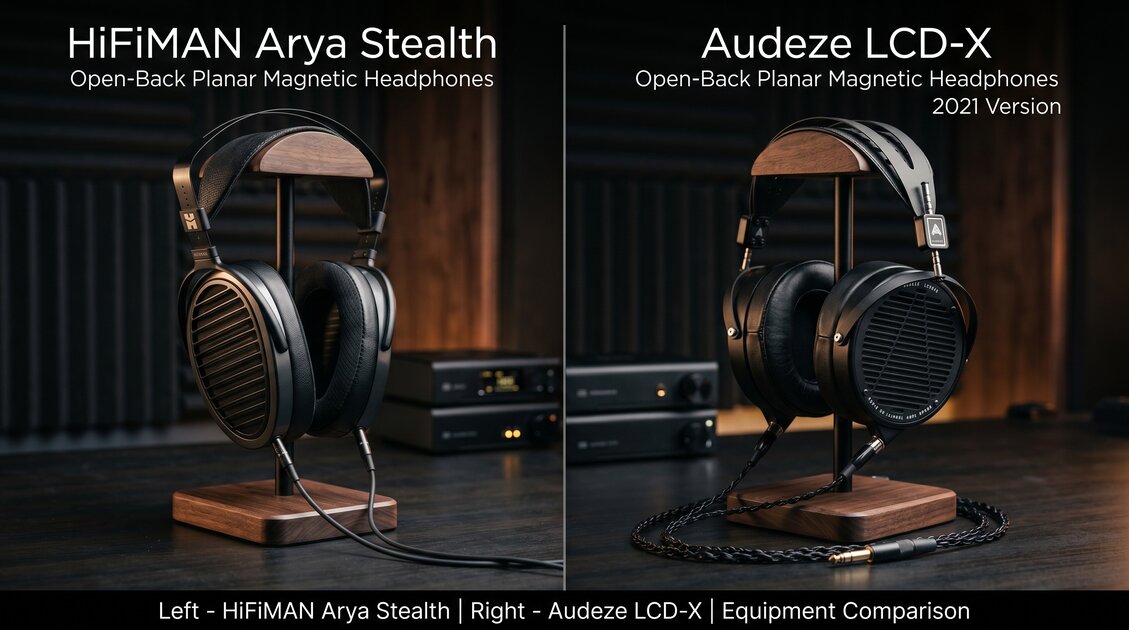
Planar magnetic headphones have dominated serious audiophile discussion for the past decade, and the HiFiMAN Arya and Audeze LCD-X represent two of the most compelling arguments for the technology. They’re priced comparably, they both use planar magnetic drivers, and they both occupy the upper tier of enthusiast listening. But they could hardly sound more different—or be designed with more fundamentally different philosophies.
Understanding that difference is the entire point of this comparison. The choice isn’t about which headphone is technically superior. It’s about which philosophy of sound you want to live with.
Specifications
| Spec | HiFiMAN Arya (Stealth) | Audeze LCD-X (2021+) |
|---|---|---|
| Driver Type | Planar magnetic, Stealth Magnets | Planar magnetic, Fazor waveguides |
| Impedance | 32 Ω | 20 Ω |
| Sensitivity | 94 dB / 1mW | 100 dB / 1mW |
| Frequency Response | 8 Hz – 65 kHz | 10 Hz – 50 kHz |
| Driver Size | ~70mm x 50mm (oval) | 106mm (circular) |
| Weight | ~430 g | ~596 g (2021+ version) |
The weight difference is immediately significant: the LCD-X is roughly 170g heavier than the Arya. Over extended listening sessions, that gap becomes a meaningful comfort factor. The Arya’s lower sensitivity (94 vs 100 dB/mW) means it needs more power to reach equivalent listening volumes despite having comparable impedance.
Audeze’s 106mm circular driver is dramatically larger than HiFiMAN’s oval format—a difference that contributes to the LCD-X’s distinctive sound character, particularly in the bass region where larger driver surface area typically delivers more air movement and physical impact.
Design and Build
HiFiMAN Arya
The Arya’s physical design uses HiFiMAN’s familiar oval ear cup format with an asymmetric suspension headband. The construction is primarily plastic with metal in structural areas. It’s functional without being luxurious—the kind of product where the engineering budget clearly went into the acoustic driver and magnet system rather than the chassis.
Comfort is genuinely good for a planar magnetic headphone. The weight is distributed effectively by the headband, and the oval cups accommodate most ear geometries without the ear making contact with the driver grille. Long sessions are feasible without significant fatigue.
Audeze LCD-X
The LCD-X uses Audeze’s characteristic circular ear cups in an angled configuration, mounted on a sprung steel headband. The construction is substantially heavier—the larger driver requires a larger, heavier chassis, and Audeze reinforces this with denser materials throughout. The earcups are typically available in various configurations including machined aluminum and wood options.
Comfort is the LCD-X’s most significant weakness. At approximately 600g, it will fatigue necks and heads over sessions longer than an hour for most listeners. This is a real limitation for home listening use, and it’s not a trivial one. The pads are excellent—breathable, well-shaped, and replaceable—but the weight is simply what it is.
Sound Signature: HiFiMAN Arya
Bass
Fast, controlled, and accurate. The Arya’s planar bass has the characteristic tightness that makes planar magnetic technology compelling: transients are sharp, decay is quick, and the character of bass instruments (weight, texture, room interaction) is communicated without additional warmth or bloom. Sub-bass reaches cleanly with the Stealth Magnet driver, and the overall low-frequency presentation rewards attentive listening to complex bass lines.
Quantity-wise, the Arya is neutral to slightly lean in the bass. It doesn’t emphasize low frequencies, and listeners coming from warmer or bass-boosted headphones will initially perceive it as thin.
Midrange
Clear and detailed with a slightly forward character. Voices and acoustic instruments have the low-distortion clarity that planar magnetic drivers do well—you hear the source cleanly without harmonic rounding. The Stealth Magnet technology contributes to a midrange that’s less colored than previous Arya generations, with complex passages resolving individual elements more clearly.
Treble
Extended and refined with the Stealth Magnet revision. The earlier Arya variants had a treble that some listeners found challenging; the Stealth version is more coherent and less prone to the peaks that made the original divisive. High-frequency extension is excellent—cymbals, strings, and upper harmonics are reproduced with texture and air.
Soundstage
The Hifiman Arya’s primary claim to fame. The spatial presentation is broad, deep, and convincingly three-dimensional. Classical recordings in particular sound like you’re physically positioned within the recording space rather than listening to a reproduction of it. Imaging precision is excellent—instruments are anchored to defined positions rather than floating across a wide zone.
Sound Signature: Audeze LCD-X
Bass
This is where the LCD-X’s 106mm driver and physical mass make their case. The bass is not just extended—it’s authoritative. The low-frequency presentation has a sense of weight and physical impact that the Arya doesn’t match. This isn’t artificial enhancement; the LCD-X’s larger driver moves more air, and the result is a sub-bass and midbass presence that sounds and feels more visceral on music that demands it. Electronic music, orchestral low brass, bass guitar—all gain a sense of physical reality that more lightweight planar designs don’t achieve.
Crucially, the bass is also textured and controlled. Audeze’s Fazor waveguide technology improves phase coherence through the driver, and the result is bass that’s heavy without being slow or poorly defined. The leading edge of kick drums is sharp; the decay reveals the recording’s room acoustics.
Midrange
The LCD-X is tuned for studio reference use, and the midrange reflects this. Vocals and instruments are rendered with careful tonal balance and strong detail retrieval. Compared to the Arya, the LCD-X’s midrange feels slightly more forward in the upper-mid frequency range (2–5 kHz), giving vocals and lead instruments a sense of presence and immediacy.
Some listeners find the Audeze LCD-X midrange too analytical or slightly dry—it does not add warmth or musicality, it simply reproduces what’s there with high accuracy. For mixing and mastering work, this is a virtue. For casual listening, it depends on your preference.
Treble
Controlled and detailed with slightly less high-frequency sparkle than the Arya. The LCD-X’s treble is well-extended but smoother in character—less air and sparkle in the upper frequencies, which contributes to a presentation that’s darker overall than the Arya. This makes the LCD-X more forgiving of bright or harsh recordings, and it significantly reduces long-session fatigue.
Soundstage
The LCD-X presents a more intimate, focused soundstage compared to the Arya. The presentation is precise rather than vast—instruments are well-imaged but the overall sense of acoustic space is smaller. For studio reference applications this is appropriate: you want to hear what’s in the mix, not have it spread out into an artificially wide acoustic environment.
Amplification
Both headphones require proper amplification—these are not casual headphones for plugging into consumer electronics.
The Arya’s 94 dB/mW sensitivity and 32-ohm impedance means it needs current. A quality desktop amplifier with balanced output (4.4mm or XLR) is the appropriate pairing. The Arya scales noticeably with better amplification and benefits from the lower noise floor of balanced connections.
The LCD-X at 20 ohms and 100 dB/mW sensitivity is somewhat easier to drive to volume, but it also benefits substantially from quality amplification and particularly responds well to amplifiers with higher output current capability. Its lower impedance means it’s more tolerant of lower-powered sources, but “tolerant” doesn’t mean it sounds its best from them.
Both headphones deserve a dedicated desktop stack. Our Best Headphone Amps Under $1000 guide covers appropriate amplification options for both.
Who Should Choose the Arya?
- Listeners who prioritize soundstage and spatial immersion above all other qualities
- Classical, jazz, and acoustic music enthusiasts who want to feel placed within a recording space
- Analytical listeners who want maximum resolution and detail retrieval
- Those who find heavy headphones uncomfortable for extended sessions
- Listeners who prefer a neutral-to-bright presentation over warmth
Who Should Choose the LCD-X?
- Music producers, mixing engineers, and studio professionals who need analytical reference headphones
- Listeners who want visceral low-frequency impact alongside planar magnetic precision
- Electronic music listeners who want bass that feels physical
- Those who prefer a more intimate, focused soundstage over a wide, diffuse presentation
- Listeners who find the Arya’s lighter bass presentation unsatisfying
Who Should Buy Neither?
- Anyone without a proper desktop amplification setup
- Casual listeners for whom either headphone’s price is disproportionate to their listening commitment
- Those who need isolation—both are open-back designs
Pros & Cons
HiFiMAN Arya
Pros:
- Extraordinary soundstage—best-in-class at this price
- Stealth Magnet technology delivers refined, coherent high frequencies
- Lighter and more comfortable for extended sessions than the LCD-X
- High resolution with fast transient response Check price on Amazon →
Cons:
- Build quality doesn’t match the acoustic performance level
- Neutral-to-lean bass won’t satisfy listeners wanting warmth or impact
- Requires substantial, quality desktop amplification
- HiFiMAN quality control inconsistencies are a documented concern
Audeze LCD-X
Pros:
- Authoritative, physically impactful bass that the Arya can’t replicate
- Industry-standard reference tuning trusted by professional engineers
- Fazor waveguides improve bass phase coherence and texture
- Durable, premium build quality Check price on Amazon →
Cons:
- ~600g is heavy—comfort is a genuine issue for long sessions
- More intimate soundstage compared to the Arya
- Treble is darker, which some find less exciting for audiophile listening
- Audeze price premium for the build is real
Frequently Asked Questions
Q: Which is better for gaming?
The Arya’s wider soundstage makes positional audio in games more convincing—you’ll hear the direction and distance of sounds more accurately. The LCD-X’s more intimate presentation is technically less ideal for positional gaming, though its bass impact makes explosions and soundtrack music feel more engaging. Neither is designed for gaming, but the Arya has the advantage for positional accuracy.
Q: Can I use either headphone for home recording and mixing?
The LCD-X is the more appropriate tool for mixing—its reference tuning, controlled bass, and focused soundstage are aligned with professional studio applications. The Arya’s wide soundstage can make center elements feel slightly displaced from their intended position in a mix, which complicates mixing decisions.
Q: Which ages better as a purchase?
Both are well-established products with proven long-term reliability (quality control concerns aside). Replacement pads and cables are available for both. Audeze’s build quality arguably means the LCD-X is a more durable long-term object, but the Arya Stealth’s acoustic technology represents a genuine advancement that holds up against much newer competition.
Conclusion
The HiFiMAN Arya and Audeze LCD-X aren’t competing for the same listener. The Arya is for those who want to disappear into a recording space, surrounded by music that seems to emanate from a three-dimensional environment beyond the headphone’s physical boundaries. The LCD-X is for those who want to understand what’s in a recording—every textured bass line, every carefully placed instrument—with the analytical precision of professional reference equipment.
Both are exceptional. Neither is the universal right answer. The honest recommendation is to identify which you’d use more: music for enjoyment and immersion, or music for analysis and production. The answer tells you which headphone to buy.