In 2026, the budget desktop DAC/amplifier market is flooded with choices. You have dozens of sub-$250 options from brands like Topping, SMSL, iFi, and FiiO. Yet, when you ask a broad range of experienced audiophiles, “what should I buy first?” the FiiO K7 remains the most common answer.
The K7 isn’t flashy. It doesn’t have a giant color screen, it doesn’t have the highest specs on a piece of paper, and it won’t impress someone looking for a “feature-heavy” device. It is a workhorse: a dual-DAC, balanced-output amplifier that gets out of the way, powers your headphones cleanly, and simply does the job. In 2026, that simplicity remains its most valuable feature.
Technical Specifications
| Spec | Value |
|---|---|
| DAC Chip | Dual AK4493SEQ |
| Output Power (Balanced) | 2000 mW (32 Ω) |
| Output Power (Unbalanced) | 1220 mW (32 Ω) |
| THD+N | < 0.0003% (at 1 kHz) |
| SNR | > 128 dB |
| Output Impedance | < 1 Ω |
| Inputs | USB, Coaxial, Optical, RCA |
| Outputs | 6.35mm (unbalanced), 4.4mm (balanced) |
The specifications are genuinely excellent for the price point. A THD+N of < 0.0003% indicates the K7 is functionally transparent—the noise floor is low enough that you won’t hear hiss, and the distortion is below the threshold of human hearing across the entire audible range. The 2000 mW of power at 32 ohms is enough to drive almost any planar magnetic or dynamic headphone currently on the market—you won’t be lacking in volume or dynamic control for the vast majority of loads.
Design and Build
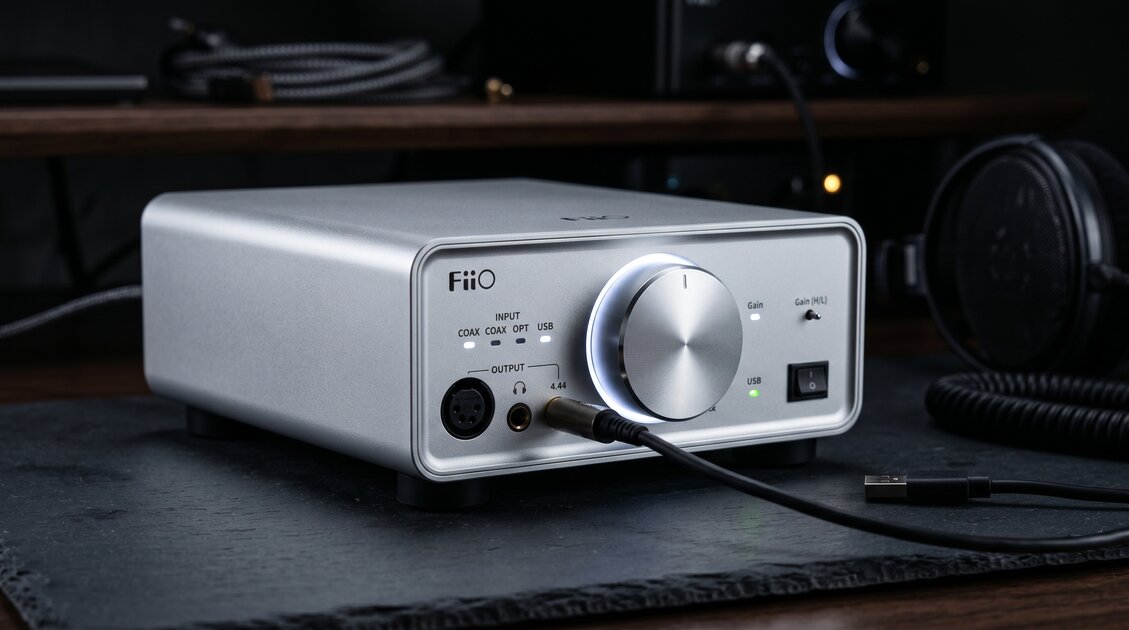
The K7 is built like a tank. The chassis is black aluminum, and the volume knob is solid, satisfying to rotate, and serves as an RGB light indicator for the sample rate (a helpful, non-intrusive feature). The front panel is uncluttered: a balanced 4.4mm output, a standard 6.35mm output, a gain switch (high/low), and an input selector.
The build quality is consistent with FiiO’s modern aesthetic: functional, sturdy, and well-manufactured. It’s not a luxury object, but it is a tool-grade desktop component. It takes up a small footprint on a desk—easily fitting under a monitor or between other gear—and it stays cool even after hours of continuous use.
Sound Signature
The K7’s character is “neutral-transparent.” FiiO tuned this device to perform as a reliable baseline—the K7 neither adds color nor masks the characteristics of the headphones you plug into it.
Resolution and Detail
The dual AKM DAC chips provide a clean, detailed presentation that reveals the nuances in recordings without artificially boosting the treble. The resolution is high enough that you can easily distinguish between high-bitrate streaming services and CD-quality files, provided your headphones are resolving enough to communicate the difference.
Amplification and Power
The K7’s power delivery is its hidden strength. The dual-amplifier circuit ensures high current output, which is what actually makes the difference for planar magnetic headphones. Planars are current-hungry; if you don’t have enough current, they sound flat, lacking in punch and sub-bass definition. The K7 provides more than enough current to bring out the speed and bass impact of headphones like the HiFiMAN Sundara or Arya.
For sensitive IEMs, the K7’s background is quiet, though at maximum volume you might hear a trace of noise on the most sensitive gear. For 99% of desktop use cases, the K7’s noise floor is effectively silent.
Source Pairing and Compatibility
The K7 plays nice with everything from IEMs to demanding open-back dynamics to power-hungry planars. It acts as an anchor for a desktop system, and because it is functionally transparent, you can focus your system-building efforts on your headphones, where the largest acoustic differences occur.
If you have a pair of Sennheiser HD 650 or a HiFiMAN Sundara, the K7 is the natural companion. It’s the “set it and forget it” solution for most users.
Who Should Buy the K7?
- New hobbyists who want a “first real desktop amp” that solves the power question for almost any headphone
- Users who need balanced output (4.4mm) to take full advantage of their gear
- Anyone who wants a functionally transparent, reliable desktop anchor
- Users with limited desk space who need a compact, all-in-one desktop solution
- Those who want a plug-and-play experience without complex drivers or setup
Who Should NOT Buy the K7?
- Users who specifically want a “warm” or “musical” character to color their headphones
- Anyone who needs advanced features like Bluetooth connectivity, complex DSP, or a massive display—consider the Topping DX3 Pro+ for more features at a similar price
- Those looking for a dedicated audiophile “collector’s” piece with boutique engineering
Pros & Cons
Pros:
- Exceptional power output (2000 mW balanced) drives demanding planars with ease
- Functionally transparent performance with excellent THD+N and SNR specs
- Robust, compact, industrial-grade aluminum build
- Dual AKM DAC chips provide neutral, detailed conversion
- 4.4mm balanced output is a standard requirement for many current audiophile headphones
Cons:
- Very basic feature set—no Bluetooth, no complex DSP, no display
- Aesthetics are functional/utilitarian, not luxury
- Gain switch is on the front (fine, but some prefer software gain)
Frequently Asked Questions
Q: Does it have enough power for my HiFiMAN Arya?
Yes. The Arya Stealth is sensitive enough that the K7’s high current output drives it well, providing the punch and control the Arya requires. You won’t feel like you are under-powering it, provided you are using the balanced output.
Q: Is the balanced output worth the upgrade?
If your headphone cable is balanced, yes—the balanced output offers higher power and technically superior channel separation. If you are using a single-ended cable, the 6.35mm output is perfectly capable.
Conclusion
The FiiO K7 in 2026 remains the definitive budget desktop choice because it understands its purpose perfectly. It doesn’t attempt to be a multi-functional device; it focuses entirely on the basics—power, clean conversion, and reliability. For under $250, you are getting performance that would have cost you double five years ago, and that’s an outstanding value. If you want an anchor for your desk that you never have to think about, the K7 is still the benchmark.