Planar magnetic headphones represent one of the two dominant transducer technologies in serious headphone audio, alongside dynamic drivers. The technology has existed since the 1970s, but the practical cost of manufacturing large, high-precision planar magnetic arrays made it prohibitively expensive for consumer products for decades. In the last several years, manufacturing advances — particularly from Chinese companies like HiFiMAN — have driven prices down dramatically, making the planar sound accessible across multiple price tiers.
In 2026, the planar magnetic headphone market spans from ~$150 (HiFiMAN HE400SE) to $4,000+ (flagship Audeze and Hifiman models). This guide covers the essential picks at each meaningful price tier, with a clear-eyed explanation of what the technology actually delivers — and where it doesn’t.
Why Planar Magnetic? The Technical Case
Planar drivers work differently from dynamic drivers in a way that has direct sonic consequences.
A dynamic driver uses a stiff cone or dome attached to a coil at a single point. The force from the coil is concentrated at that attachment, and the cone must be rigid enough to transmit that force to the air without flexing inconsistently — a mechanical challenge that introduces resonance and distortion at various frequencies.
A planar driver uses an ultra-thin membrane (often measured in nanometers of thickness) with conductive traces spread across its entire surface. Magnets on both sides of the membrane interact with these traces simultaneously across the whole surface area. The entire membrane moves uniformly, without flex, without the single-point drive issue of a dynamic driver.
The practical consequences:
- Lower distortion, especially at high listening levels
- Faster transient response — the membrane has dramatically lower mass than any cone driver
- More controlled bass — the bass doesn’t bloom or slow down under load the way dynamic bass can
- Unique bass texture — planar bass has a distinctive character that listeners either love immediately or need time to understand
The trade-off is that planar magnetic headphones typically require more power to drive than comparable dynamic designs, and the large magnet arrays make them heavier. Both of these factors vary significantly by model.
1. HiFiMAN HE400SE — Entry-Level Planar (Under $150)
Impedance: 25Ω | Sensitivity: 91 dB | Weight: ~440g
The HE400SE is where most audiophiles have their first encounter with planar magnetic sound, and it’s a reasonable first encounter. The planar bass — tight, textured, free from the bloom that characterizes dynamic driver budget headphones — is the immediate and striking advantage. The soundstage is wide and open. The tuning is broadly neutral, making it more versatile than specifically “fun-tuned” budget headphones.
Build quality is the defining limitation: the plastic housing, basic headband, and considerable weight make extended sessions uncomfortable for some users. The 91dB sensitivity demands a proper source — a desktop DAC/amp is effectively required to hear what the HE400SE can do.
For the curious listener who wants to understand what planar technology sounds like without spending $300+, the HE400SE answers the question for an accessible price.
Full review: HiFiMAN HE400SE Review 2026
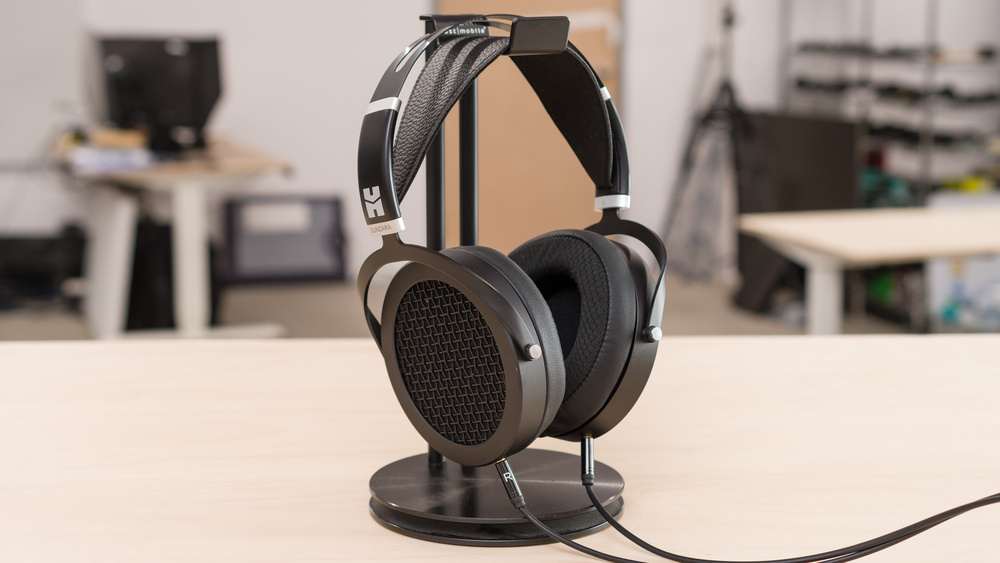
2. HiFiMAN Sundara — The Benchmark Mid-Fi Planar (Under $350)
Impedance: 37Ω | Sensitivity: 94 dB/mW | Frequency response: 6Hz – 75,000Hz
The Sundara has held the “best value planar” title for multiple years running, and in 2026 it maintains that position. The jump from the HE400SE to the Sundara is significant: better build quality, noticeably more refined treble, cleaner midrange, and a more accurate overall tuning that sits closer to the Harman target.
The planar magnetic driver in the Sundara uses HiFiMAN’s “nanometer-grade” diaphragm, which is thinner and faster than the HE400SE’s driver. The result is more precise transients, lower distortion at high listening levels, and a more effortless top-end extension. The soundstage is wide and spatially accurate — better imaging geometry than any dynamic headphone at the price.
The tuning is neutral-to-bright. The treble is present and energetic — a characteristic of most planars — which benefits detail-rich music but can expose poorly mastered recordings sharply.
Build quality is the consistent HiFiMAN criticism: the adjustment mechanism and housing materials don’t feel as premium as the driver quality deserves. Comfort is adequate; the weight is manageable for most sessions.
Full review: HiFiMAN Sundara Review 2026
3. HiFiMAN Arya Stealth — The Wide-Stage Flagship Alternative (Under $1,300)
HiFiMAN Arya Stealth on Amazon
Impedance: 32Ω | Sensitivity: 94 dB | Frequency response: 8Hz – 65,000Hz
The Arya Stealth is where HiFiMAN’s “stealth magnet” technology — magnets shaped to minimize acoustic diffraction — reaches a level where it genuinely transforms the listening experience relative to the Sundara. The soundstage is the Arya’s defining attribute: it is among the widest and most three-dimensionally convincing soundstages of any headphone at any price. Classical orchestral recordings and spatially complex jazz become genuinely immersive experiences in a way that the Sundara, despite its good staging, can’t fully match.
The resolution is a step up as well: fine micro-details in recordings — room ambience, subtle instrument overtones, the acoustic space of a recording venue — are rendered with more clarity and less masking than the Sundara provides.
The tuning is similar in character to the Sundara — neutral-to-bright, with planar energy in the treble — but better calibrated and more consistent across the frequency range. The bass is deep and controlled. The midrange is transparent.
HiFiMAN’s build quality at this price tier is improved over the entry-level offerings, but the Arya still doesn’t feel as solidly constructed as Audeze or Focal products at similar prices.
Best for: Classical music, jazz, large-scale orchestral recordings, listeners who prioritize soundstage above all else.
4. Audeze LCD-X — The Studio Standard Planar
Impedance: 20Ω | Sensitivity: 103 dB/mW | Frequency response: 10Hz – 50,000Hz
Weight: ~612g (with pads)
The Audeze LCD-X represents a fundamentally different design philosophy from HiFiMAN’s planar approach. Where HiFiMAN planars tend to be large-bore, wide-staging, bright-leaning designs, the LCD-X is dense, powerful, and focused. The bass is the most impressive attribute: deep, physical, and extended in a way that is genuinely visceral on music that demands it. Bass-heavy genres — hip-hop, electronic, film scores — take on a presence and weight that few headphones can replicate.
The LCD-X’s frequency response is closer to neutral-warm than neutral-bright — it has real low-frequency body, natural midrange density, and a controlled (not emphasized) treble. This makes it more immediately accessible to a wide range of listeners and less fatiguing on long sessions than bright-leaning planars.
At ~612g, it is significantly heavier than any HiFiMAN offering. This is a desk headphone — put it on and sit in your chair. The weight becomes uncomfortable if you try to move around with it.
The build quality is the LCD-X’s other defining characteristic: an aluminum chassis, handcrafted in the USA, with premium leather and memory foam earpads. It is built to last indefinitely and feels like a professional instrument.
At 103dB sensitivity and 20Ω impedance, the LCD-X is relatively easy to drive compared to some competitors, but still benefits from quality amplification.
Best for: Studio monitoring, music production, bass-heavy genre listening, anyone who wants the most physically impactful planar bass experience.
5. ZMF Tessidera — The Boutique Planar Flagship ($2,500+)
Impedance: 32–40Ω | Sensitivity: 96 dB/mW | Weight: ~500g
The ZMF Tessidera is a unique entry in the planar world. ZMF, known for their wood-bodied dynamic driver headphones, has applied their “house sound” — warm, musical, and organic — to a planar driver. While most planars lean toward analytical precision, the Tessidera prioritizes emotional engagement and tonal richness.
It features stunning solid hardwood cups and ZMF’s legendary suspension headband, making it one of the most comfortable and beautiful headphones in the flagship tier. If you want the speed of a planar but the soul of a ZMF dynamic driver, this is the definitive choice.
Full review: ZMF Tessidera Review
Do Planar Headphones Need Special Amplifiers?
Yes — more than most dynamic headphones. The typical sensitivity figure for a planar (91–94 dB) is lower than a typical dynamic headphone (100–104 dB), which means you need more voltage from your amplifier to reach the same listening level. Additionally, planar magnetic loads can present challenging impedance characteristics that vary with frequency, which affects amplifier output power.
The practical takeaway: a dedicated headphone amplifier is not optional for serious planar listening. A quality amplifier — the FiiO K7, Topping A90 Discrete, Schiit Magni Heresy, iFi Zen CAN, or similar — is a worthwhile investment alongside any planar in this guide. For the LCD-X, budget for a full desktop DAC/amp stack. For a headphone amplifier buying guide, read our dedicated amp guide.
Planar vs. Dynamic — Which Should You Choose?
Neither technology is objectively superior for all listeners and all music. The practical guidance:
Choose planar if:
- You prioritize bass texture and control over bass quantity
- You want the fastest transient response available (guitar plucks, piano attacks, drum hits with natural snap)
- You listen primarily to acoustic music, jazz, classical, or complex electronic music where resolution and staging clarity matter
- You have proper amplification and a desk-based listening setup
Choose dynamic if:
- You want warm, musical, fun-colored sound — many excellent dynamic headphones deliver this better than planars
- You need easy drivability from portable sources
- Weight and wearability for extended mobile use matter to you
- Your budget is under $150 and you want the most reliable, comfortable experience
Both technologies have a place in a serious listening collection. Many audiophiles own examples of each.