The $150–200 price range is where the audiophile world starts to get genuinely interesting. Below this threshold, you’re either making significant compromises in sound quality, build longevity, or driver technology. At this level, the compromises start to disappear — or at least become acceptable trade-offs rather than deal-breakers. In 2026, you can buy a headphone under $200 that outperforms the boutique headphones that cost triple this price a decade ago.
This guide covers the best options at this price point, organized by use case, with honest information about what each does well and what it doesn’t.
1. Sennheiser HD 560S — The Neutral King
Driver type: 38mm dynamic, open-back
Impedance: 120Ω
Sensitivity: 110 dB/Vrms
Frequency response: 6Hz – 38,000Hz
The HD 560S is the most technically accurate headphone in this price range. Its tuning closely follows the Harman over-ear target — the closest thing the headphone industry has to a scientifically validated “correct” frequency response. That means the bass is extended but not boosted, the midrange is honest and present, and the treble is bright without being harsh.
For audio production, home mixing, or anyone who wants to hear exactly what is in a recording — not what sounds “good” — the HD 560S is the correct tool. It’s also exceptionally comfortable: at ~240g with velour earpads and an auto-adjusting headband, it is one of the most wearable headphones at any price. It drives acceptably from a dongle DAC without demanding a full desktop amplifier stack.
The downside: it won’t entertain you the way a warm, V-shaped headphone will. First-time listeners sometimes find it thin or dull. Give it time — what you’re hearing is accuracy, not deficiency. And it’s open-back, so it provides zero noise isolation.
Full review: Sennheiser HD 560S Review 2026
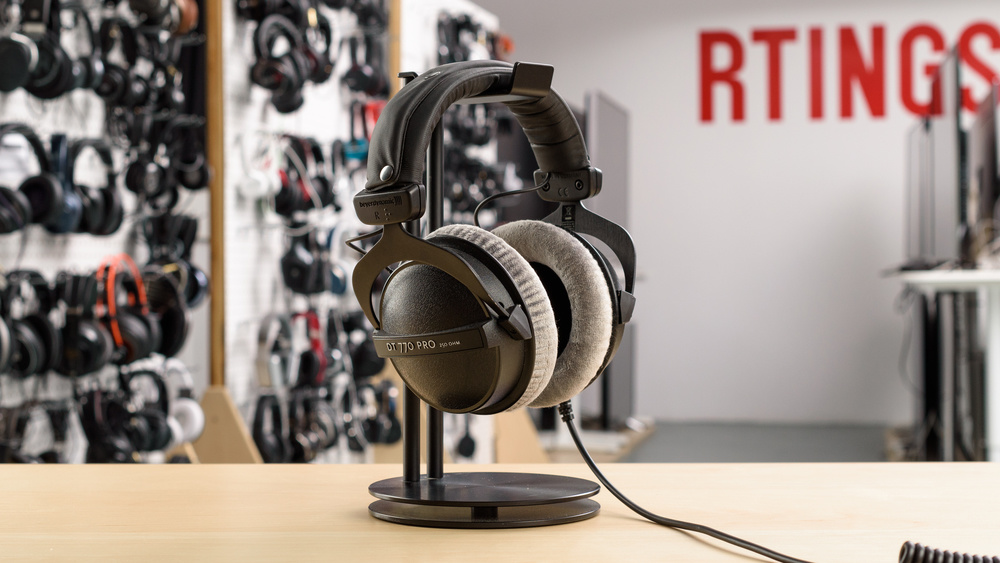
2. Beyerdynamic DT 770 Pro — The Isolation Pick with Premium Build
Driver type: 45mm dynamic, closed-back
Impedance: 32/80/250Ω (choose based on your source)
Sensitivity: 96 dB SPL
Frequency response: 5Hz – 35,000Hz
The DT 770 Pro is the closed-back recommendation for this tier. Its V-shaped sound signature — elevated bass, recessed midrange, bright treble — is energetic and satisfying for casual listening across most popular genres. The bass has real impact and extension, making it genuinely fun on bass-heavy music.
What distinguishes the DT 770 Pro from cheaper closed-backs is the build quality and the earpads. Beyerdynamic manufactures these in Germany with steel and aluminum construction, and the velour earpads provide long-session comfort that plastic pleather alternatives simply can’t match. Replacement parts — pads, cables, headbands — are all available, making this a headphone you can maintain for a decade.
The 250Ω version provides the best sound but requires a proper amplifier. For phone or laptop use without an amp, buy the 32Ω or 80Ω version. Be honest about your source before selecting the impedance variant.
Full comparison: Beyerdynamic DT 770 Pro vs DT 990 Pro
3. HiFiMAN HE400SE — The Planar Budget Entry Point
Driver type: Planar magnetic, open-back
Impedance: 25Ω
Sensitivity: 91 dB
Frequency response: 20Hz – 20,000Hz
The HE400SE offers something genuinely unique at this price: a planar magnetic driver. This technology, previously exclusive to $500+ headphones, delivers bass reproduction that is qualitatively different from dynamic drivers — tighter, more textured, less prone to bloat or distortion. The sub-bass extension is real and audible, not just a measurement artifact.
The HE400SE’s tuning is broadly neutral, and its soundstage is surprisingly wide for the price. However, the build quality is clearly the weakest of the three options here — the headband is basic, the weight (440g) is noticeably heavier, and the plastic housing doesn’t inspire confidence. It also needs a proper source to perform: at 91dB sensitivity, you need at minimum a quality dongle DAC, and preferably a small desktop amp, to drive it to its potential.
If you’re curious whether you prefer planar sound over dynamic sound — and if you have a desk setup to drive it properly — the HE400SE answers that question for an accessible price.
Full review: HiFiMAN HE400SE Review 2026
Why Avoid Gaming Headsets in This Price Range?
Gaming headsets in the $150–200 range are competing for the same marketing budget as audio quality. A typical $200 gaming headset includes:
- RGB lighting
- A USB dongle with virtual surround processing
- A built-in boom microphone of varying quality
- 7.1 virtual surround “technology” that often degrades rather than improves imaging
- Drivers that prioritize exciting-sounding frequency response over accuracy
Any of the three headphones above will provide dramatically better soundstage, imaging, and detail retrieval than a same-priced gaming headset. You lose the integrated microphone — which you can replace with a desktop boom mic or a ModMic attachment for ~$30–70 — but you gain a headphone that will be genuinely satisfying to use for music, podcasts, and gaming equally.
The soundstage in particular matters for gaming: a wide, accurately imaging open-back like the HD 560S or DT 990 Pro renders positional audio (footsteps, gunshots, directional cues) more precisely than most gaming headsets with virtual surround processing.
What Should You Pair These With?
Even at this price, a source upgrade matters. These headphones are resolving enough to benefit from clean amplification:
- Budget option: Any quality dongle DAC (FiiO KA3, Apple USB-C adapter, Qudelix 5K) — $15–70. Sufficient for the HD 560S and HE400SE.
- Mid option: A dedicated desktop DAC/amp combo like the Topping DX3 Pro+ or Schiit Hel — $120–180. Opens up dynamics, improves instrument separation on all three headphones.
- Interface option: If you already have a USB audio interface (Focusrite Scarlett, etc.) for recording, use it — it will drive all of these headphones well.
For more on pairing these headphones with the right amplification, read How to Choose a Headphone Amplifier: The Complete Guide 2026.
Buying Guide Summary
Get the HD 560S if: You want the most accurate, neutral sound for mixing, critical listening, or gaming in a quiet environment. It’s the most technically honest headphone here.
Get the DT 770 Pro if: You need isolation — for recording, office use, or a noisy environment — and want fun, impactful sound with bulletproof build quality.
Get the HE400SE if: You’re specifically curious about planar magnetic technology and its unique bass character, and you have a proper desktop source to drive it.
All three represent genuine value at their price point. None of them is wrong. But they serve different listening situations, and identifying which situation you’re in will point you to the right choice.