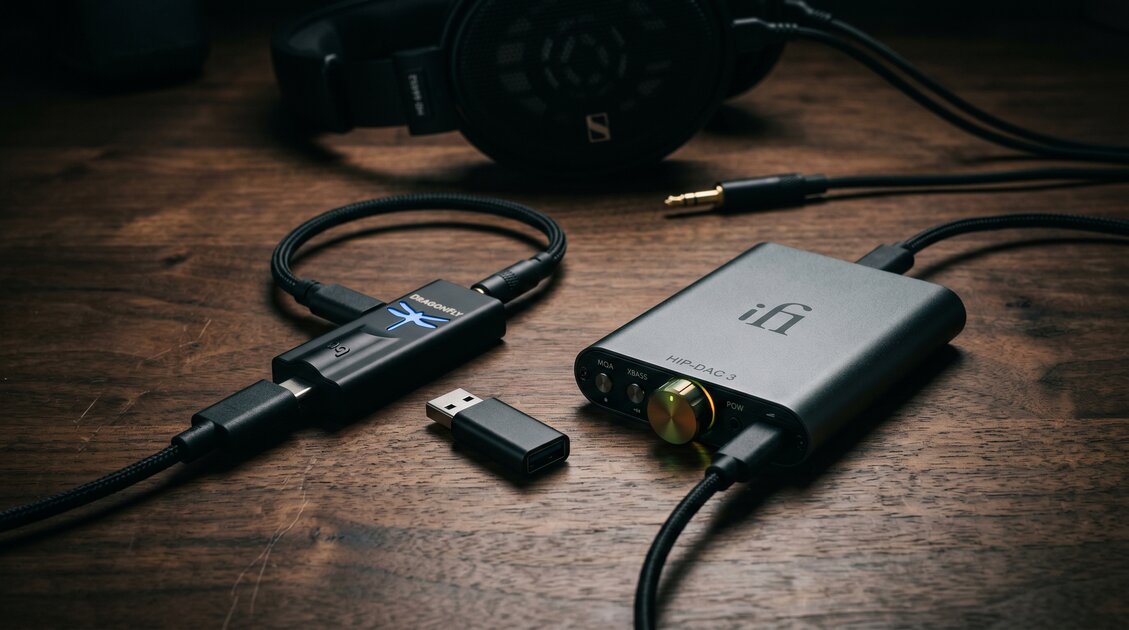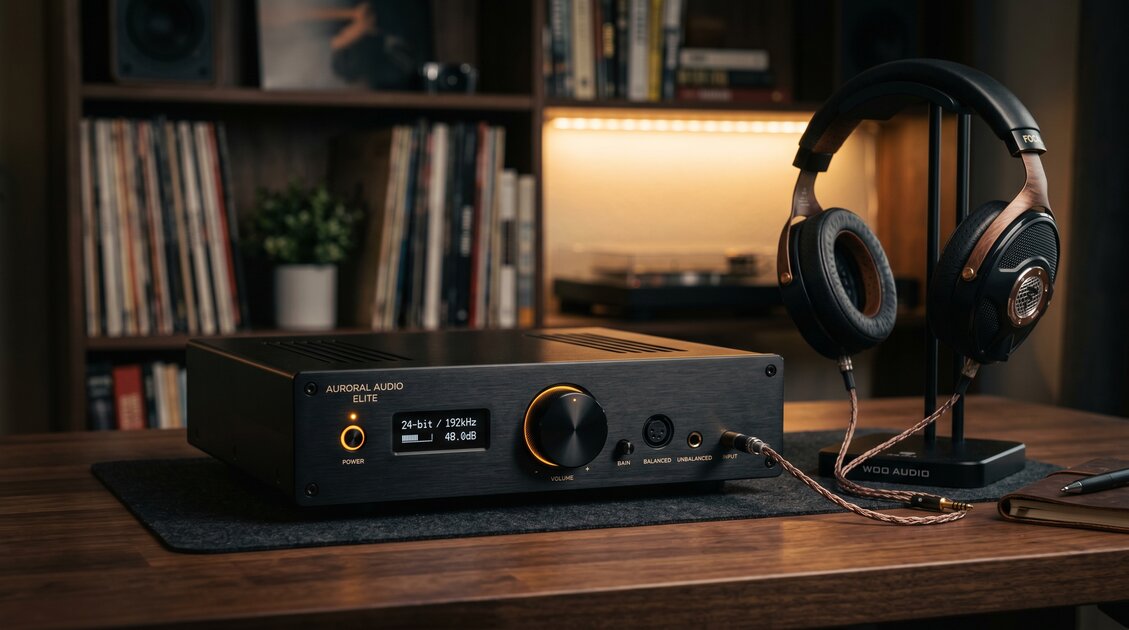
The desktop DAC/amp market in 2026 is genuinely excellent across every price bracket. Fierce competition from Chinese manufacturers like FiiO, Topping, and SMSL has forced everyone — including established Western brands — to either improve or drop their prices. The result is that a $200 stack today outperforms what cost $600 five years ago.
But with so many options, the decision paralysis is real. This guide is organized by budget tier so you can find a recommendation without wading through endless marketing specs.
For a deeper primer on what to look for before buying, read How to Choose a Headphone Amplifier: The Complete Guide 2026.
What Is a Desktop DAC/Amp Combo?
A DAC (Digital-to-Analog Converter) takes the digital signal from your computer or phone and converts it to an analog voltage. An amplifier takes that analog signal and multiplies it to a level your headphones can use effectively. Many products combine both into a single chassis — a DAC/amp combo — which simplifies setup and often improves value.
Some combos are all-in-one integrated units. Others are separate DAC and amp boxes that share an aesthetic and are sold as a “stack.” Both approaches are valid; the stack approach gives you slightly more flexibility and often better channel separation.
Under $200: The Budget Kings
FiiO K7
Price: ~$180 | Chipset: Dual AK4493SEQ | Output: 4.4mm balanced + 6.35mm SE Check price on Amazon →
The FiiO K7 is the single best integrated DAC/amp under $200 for desktop use. It outputs 2,000 mW into 32Ω on the balanced output and has an excellent implementation of the AKM AK4493SEQ — warm, detailed, and non-fatiguing. The noise floor is low enough for sensitive IEMs. The K7 handles everything from 16Ω IEMs to 600Ω Beyerdynamic flagships with ease.
What makes it stand out at this price: the balanced headphone output (4.4mm Pentaconn) and the line output for active speakers, all in a solid aluminum chassis. USB-C input, optical, coaxial — it covers nearly every source.
Best for: First-time desktop setup owners, HD 600/650 users, anyone who wants balanced output without spending $400+.
SMSL SH-9 + SU-9n Stack
Price: ~$350 combined | Chipset: ES9038Q2M (DAC) | Output: 4-pin XLR balanced + 6.35mm SE
If you want the separation and flexibility of a proper stacked setup without going to the mid-range tier, the SMSL SU-9n DAC paired with the SH-9 amplifier gives you XLR balanced output, a fully differential circuit path, and measurements that rival units costing twice as much. THD+N on the SH-9 is around -120 dB — essentially below the measurement floor. This is about as transparent as solid-state amplification gets.
Best for: Planars, high-impedance dynamics, anyone who values measurement performance above all else.
$250–$500: The Sweet Spot
iFi Zen DAC V3 + ZEN CAN Stack
Price: ~$400–$450 combined | Output: 4.4mm balanced + 6.35mm SE Check price on Amazon →
The iFi ZEN ecosystem is the most complete value stack in this price tier. The ZEN DAC V3 improves on its predecessor with a lower noise floor, better balanced output swing, and a new USB-C input. Paired with the ZEN CAN amplifier, you get a genuinely musical, slightly warm sound signature that works exceptionally well with colder, more analytical headphones.
The ZEN CAN also has a unique 3D sound enhancement circuit that can be switched in for certain genres — it adds a believable sense of depth without smearing the image. Not everyone will use it, but it costs nothing to have.
Best for: Listeners who want musicality over strict neutrality; works great with Sennheiser HD 600/650, ZMF headphones, and Meze.
Topping DX5 Lite
Price: ~$300 | Chipset: AK4499EX | Output: 4.4mm balanced + 6.35mm SE Check price on Amazon →
Topping’s DX5 Lite is a fully integrated unit (DAC + amp in one box) that punches well above its price. The AK4499EX implementation is excellent, with SINAD measurements consistently above 120 dB. It supports Bluetooth 5.0 with LDAC, which is a genuine convenience addition for phone users.
The amplifier section outputs a solid 1,600 mW into 32Ω balanced, and the noise floor is essentially inaudible even with 110 dB+ sensitivity IEMs.
Best for: Anyone who wants a single box with Bluetooth and balanced output without a messy stack.
$500+: The High-Performance Tier
Chord Mojo 2 (Portable/Desktop Hybrid)
Price: ~$650 | Technology: FPGA-based filtering | Output: 3.5mm (dual)
The Chord Mojo 2 occupies its own category. It is technically a portable unit but performs as a reference desktop DAC/amp in most contexts. Chord’s FPGA-based filter architecture (WTA filtering, 5th generation) results in extraordinary time-domain accuracy and a sense of “coherence” in the music that is genuinely difficult to describe but easy to hear on a good set of headphones.
The Mojo 2 adds a four-element DSP EQ not found on the original Mojo — accessible via the ball illumination system (confusing at first, powerful when learned). It supports up to 768 kHz PCM and DSD512.
Limitations: No standard 6.35mm output (uses 3.5mm), no balanced output, and the proprietary charging port is fragile if abused. But sonically, it is exceptional.
Best for: Audiophiles who want desktop performance with the option to use the unit portably; those who prioritize sound quality over features.
iFi Gryphon
Price: ~$650 | Technology: Burr-Brown TrueBit DAC | Output: 4.4mm balanced + 6.35mm SE Check price on Amazon →
The iFi Gryphon is iFi’s most ambitious portable device, but like the Mojo 2, it functions equally well as a desktop unit. It has LDAC Bluetooth, a full-band noise shaping system (iFi calls it “XBass” and “XSpace”), and a genuine balanced amplifier section with enough power for planar headphones.
What distinguishes the Gryphon from the Mojo 2 is versatility: it has USB-C, 4.4mm balanced output, and Bluetooth all in one unit. If you want a single device that works at your desk and in your bag, there is nothing better at this price.
Best for: Power users who need one device for home and travel; planar headphone owners.
What About Flagship Gear?
Above $1,000, the returns diminish quickly. Units like the Ferrum ERCO, Benchmark HPA4, or SPL Phonitor X offer genuinely better amplifier topologies and improved power delivery for extremely demanding loads. But for 95% of headphones — including the Focal Clear Mg, Sennheiser HD 800S, and HiFiMAN Arya — the $300–$500 tier above is fully sufficient.
The Focal Clear Mg is a great example of a headphone that scales with amp quality, but you will hear 90% of its capability from a FiiO K7 and the last 10% from a $2,000 stack. Where you draw that line is a personal decision.
Buying Guide: Key Questions to Ask Before You Buy
1. Do you need balanced output? Balanced connections provide better channel separation and often more power. Most headphones above $300 come with a balanced cable option. If your headphones are balanced-capable and your DAC/amp has balanced outputs, use them.
2. Do you need Bluetooth? For phone users who switch between headphones and speakers, Bluetooth input (LDAC or aptX Adaptive) is genuinely useful. Not a sonic priority, but a real convenience.
3. What headphones do you own (or plan to own)? Match the amp output power to your headphone’s impedance. IEMs need a clean, low-noise output. High-impedance dynamics need voltage swing. Power-hungry planars need current.
4. What inputs do you need? USB for computers. Optical for TVs or game consoles. Coaxial for CD players or some streaming devices. Most modern units include all three.
5. What’s your desk situation? If desk space is tight, an all-in-one unit is cleaner. If you have room and want flexibility, a stack gives better long-term upgrade paths.
Summary: Our Top Pick Per Tier
| Budget | Top Pick |
|---|---|
| Under $200 | FiiO K7 |
| $200–$350 | SMSL SH-9 + SU-9n Stack |
| $350–$500 | Topping DX5 Lite or iFi ZEN Stack |
| $500–$700 | Chord Mojo 2 or iFi Gryphon |
| $700+ | Ferrum ERCO, Benchmark HPA4 |
Most readers landing here will be best served by the FiiO K7 or the iFi ZEN stack. They cover the vast majority of headphone pairings, they measure excellently, and they will not become obsolete when you upgrade your headphones.
For more detail on the amplifier side specifically, see Best Headphone Amplifiers Under $1000 (2026).