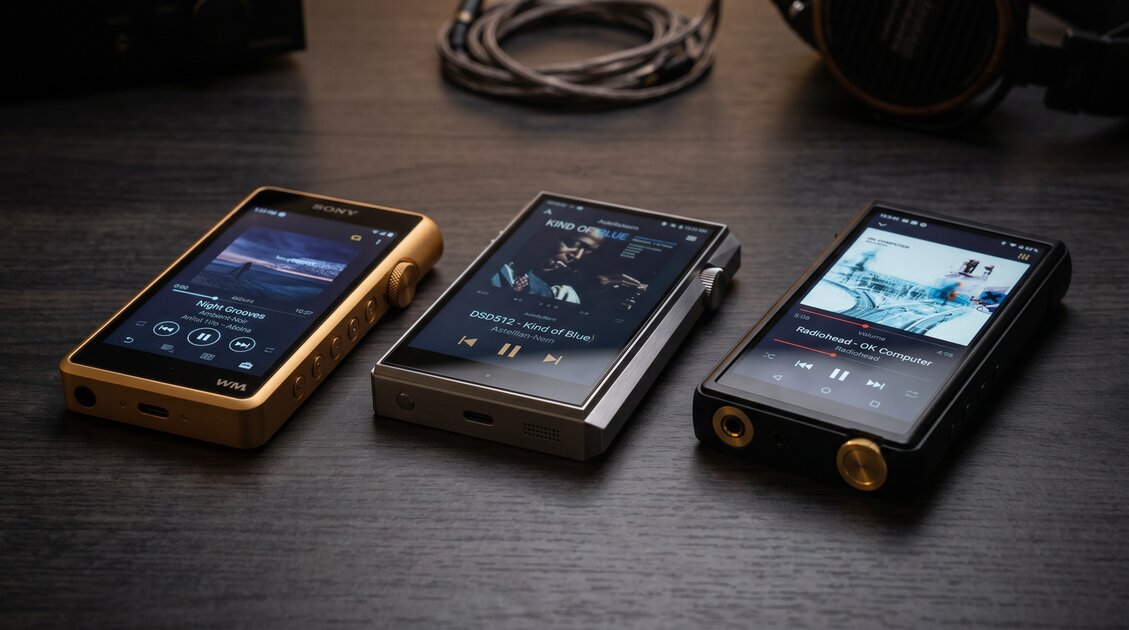
The dedicated Digital Audio Player (DAP) occupies a peculiar position in 2026: smartphones are more powerful than ever, yet the dedicated player market continues to grow. This is not a paradox — it is the expected result when serious audio engineering competes against the constraints of mass-market phone design.
A flagship smartphone carries a DAC, an amplifier, a cellular radio, a GPS module, and a camera array all on the same PCB. The RF interference alone is a constant engineering challenge. A dedicated DAP eliminates most of this noise at the source: the audio circuitry is isolated, the power supply is purpose-built, and the output stage can be optimized for headphones rather than being an afterthought squeezed into a 6mm chassis.
This guide covers the best DAPs of 2026 — from the value-accessible to the genuinely end-game — with real performance context for each.
Why Use a DAP in 2026?
Lower noise floor: Phones are electrically noisy environments. Sensitive IEMs reveal hiss on most phones. A quality DAP measures a noise floor 15–30 dB lower than even the best phone audio.
Bit-perfect local playback: Most phones apply system-level audio processing that interferes with playback fidelity. DAPs with dedicated audio chips and Android-based OSDK give you true bit-perfect delivery of FLAC, DSD, and MQA files directly to the output stage.
Balanced output: Nearly all mid-range and flagship DAPs in 2026 include 4.4mm Pentaconn balanced output, doubling voltage swing and reducing crosstalk compared to single-ended. Phones rarely offer this.
Purpose-built amplifier: DAP amplifier sections are sized for headphones, not for speaker drivers in earbuds. The current delivery for demanding planars like the HiFiMAN Sundara is simply in a different league.
No distractions: A DAP does not receive calls, notifications, or updates during your listening session. For focused, distraction-free listening, the dedicated device wins.
Top DAP Picks for 2026
FiiO M11S — The Value Champion
Price: ~$500 | Chipset: ES9038Q2M | Output: 4.4mm balanced + 3.5mm SE + coaxial Check price on Amazon →
The FiiO M11S is the sweet spot of the DAP market in 2026: enough performance to satisfy serious audiophiles, without the stratospheric price of flagship units.
Key specs:
- DAC chip: ESS ES9038Q2M
- Output power (balanced, 32Ω): ~560 mW
- Output power (SE, 32Ω): ~220 mW
- THD+N: < 0.0003% (balanced)
- SNR: > 122 dB
- Noise floor: < 1 µV (balanced IEM output)
- Battery: ~15 hours (SE playback)
- OS: Android 10 with streaming app support
- Storage: 2× microSD slots + 64GB internal
- Bluetooth: 5.0, LDAC + aptX HD
The M11S is FiiO’s most refined single-DAC-chip player, and the ES9038Q2M implementation is excellent. The balanced output is powerful enough for mid-impedance planars and most dynamic headphones. The Android OS means Spotify, Tidal, and Qobuz work natively.
Sound character: The ES9038Q2M implementation in the M11S leans toward precision and neutrality. The treble is extended and detailed; the midrange is clean without being thin; the bass is tight. It works exceptionally well with warm or V-shaped headphones that benefit from a neutral source.
Best for: First-time DAP buyers; those who want streaming + local playback; HiFiMAN Sundara and similar planar users.
Shanling M3 Ultra — The Musical Midfield
Price: ~$400 | Chipset: ES9219C × 2 | Output: 4.4mm balanced + 3.5mm SE
The Shanling M3 Ultra punches above its price bracket in sound quality and playback endurance. Shanling’s implementation of the dual ES9219C chipset prioritizes an analog warmth that many listeners describe as “organic” — there is a naturalness to the transient response and a density in the midrange that makes long listening sessions effortless.
Key specs:
- Output power (balanced, 32Ω): ~400 mW
- SNR: > 122 dB (balanced)
- Battery: ~18 hours (SE playback)
- Storage: microSD + 32GB internal
- OS: Shanling OSDK (lightweight, non-Android)
- Bluetooth: 5.0, LDAC
The non-Android OS means no direct streaming apps — you use local files or pair via Bluetooth from a phone. For purists who carry a carefully curated local music library, this is not a drawback. The simplified OS also contributes to the exceptional battery life.
Sound character: Warmer and more analog-feeling than the FiiO M11S. Better suited to neutral or brighter headphones. Pairs beautifully with the Beyerdynamic DT 1990 Pro (whose treble lift is tamed by the M3 Ultra’s warmer tuning) or with most IEMs.
Best for: Audiophiles who primarily use local files; those who prefer warmth over clinical accuracy; long-session commuters or travelers.
HiBy R6 III — Best Android DAP Under $600
Price: ~$550 | Chipset: ES9038Q2M | Output: 4.4mm balanced + 3.5mm SE + 6.35mm
The HiBy R6 III offers the best build quality and interface experience of any sub-$600 DAP in 2026. HiBy’s custom Darwin architecture on top of Android 12 results in a more polished UI than most competitors, and the physical hardware — double-sided glass, stainless steel frame, responsive volume wheel — feels genuinely premium.
Key specs:
- Output power (balanced, 32Ω): ~750 mW
- THD+N: < 0.00013% (balanced)
- SNR: > 122 dB
- Bluetooth: 5.0, LDAC + aptX Adaptive
- Battery: ~13 hours (balanced)
- Storage: microSD + 64GB internal
- Unique feature: 6.35mm (1/4") adapter included for full-sized headphones
The R6 III is slightly more powerful than the M11S balanced output, and the THD+N is lower. For users who want the best measurements in the sub-$600 Android DAP bracket, the R6 III is the choice.
Sound character: Closer to neutral-transparent than warm. The slightly elevated treble energy suits warm headphones. With the HiFiMAN Sundara on balanced, it is an outstanding system pairing.
Best for: Power users who need a polished Android DAP with streaming apps; HiFiMAN and Audeze planar users; those who want the most power at this price.
iBasso DX320 — The Flagship Reference
Price: ~$1,200 | Chipset: Dual ES9039MPRO | Output: 4.4mm balanced + 3.5mm SE
For those whose budget stretches to the flagship tier, the iBasso DX320 is the 2026 reference point for portable audio. The dual ES9039MPRO implementation delivers a noise floor below 1 µV in balanced mode — a measurement that challenges dedicated desktop DACs.
Key specs:
- Output power (balanced, 32Ω): ~1,900 mW
- THD+N: < 0.0002% (balanced)
- SNR: > 130 dB
- Noise floor (balanced): < 0.8 µV
- Battery: ~12 hours (balanced moderate use)
- OS: Android 11 with iBasso optimizations
At this level, the DX320 drives HiFiMAN Arya Stealth and Audeze LCD-X with authority from the balanced output alone — no portable amp needed. It represents the true end-game of portable playback without needing an external amplifier.
Best for: End-game portable listeners; owners of demanding flagships who refuse to compromise on mobile listening quality.
Choosing Your DAP: Key Questions
1. Do you need streaming apps? Android-based DAPs (FiiO M11S, HiBy R6 III, iBasso DX320) support Spotify, Tidal, and Qobuz directly. Non-Android players (Shanling M3 Ultra with OSDK) require local files or Bluetooth streaming from a phone.
2. What headphones do you own? Check the balanced output power at your headphone’s impedance. For the HiFiMAN Sundara (32Ω), even 300–400 mW balanced is sufficient. For the HD 600 (300Ω), you need a DAP with enough voltage swing at that impedance — typically 100–200 mW at 300Ω (the M11S delivers ~170 mW at 300Ω balanced).
3. How important is battery life? Long-haul travelers should prioritize the Shanling M3 Ultra (18 hours) or FiiO M11S (15 hours). The flagship iBasso units offer less battery life in exchange for more power.
4. Do you use IEMs? For sensitive IEMs, noise floor is the critical spec. Any unit with a balanced noise floor < 2 µV is excellent. The HiBy R6 III, M11S, and Shanling M3 Ultra all qualify.
Pros & Cons Summary
| DAP | Strengths | Weaknesses |
|---|---|---|
| FiiO M11S | Value, streaming, balanced power | Average build vs. competition |
| Shanling M3 Ultra | Battery, warmth, build | No Android/streaming |
| HiBy R6 III | UI, build, measurements | Price premium over M11S |
| iBasso DX320 | Flagship power, noise floor | Price, size |
FAQ
Q: Is a $500 DAP worth it over just using a phone + dongle DAC? For casual listening, no. For dedicated listening sessions with demanding headphones, yes. A DAP at $500 delivers better amplifier performance, lower noise floor, and longer battery life than a phone + dongle in nearly every measurable way.
Q: What music formats do 2026 DAPs support? All major DAPs support FLAC, WAV, AIFF, DSD (DSF/DFF), and AAC. Most also support MQA (though MQA’s future is uncertain). For practical purposes: rip your CDs to FLAC, download lossless from Qobuz or Apple Music, and your DAP will handle everything without issue.
Q: Do I need a separate amp for a DAP? Not for most headphones. The FiiO M11S, HiBy R6 III, and iBasso DX320 all have sufficient output for 95% of headphone pairings. Only truly demanding planars (HiFiMAN HE-6se, Audeze LCD-4) would benefit from an added amp, and at that point you have left the portable use case.
Conclusion
The DAP market in 2026 rewards careful matching. If you are just getting started, do not overspend on the player — put the extra budget toward solid IEMs or headphones first. The FiiO M11S or Shanling M3 Ultra will serve you well through multiple headphone upgrades. When your headphones reach flagship territory, that is when the iBasso DX320 or HiBy R6 III make economic sense. All four are genuinely excellent devices — the right one is simply the one that matches your specific headphones and listening habits.