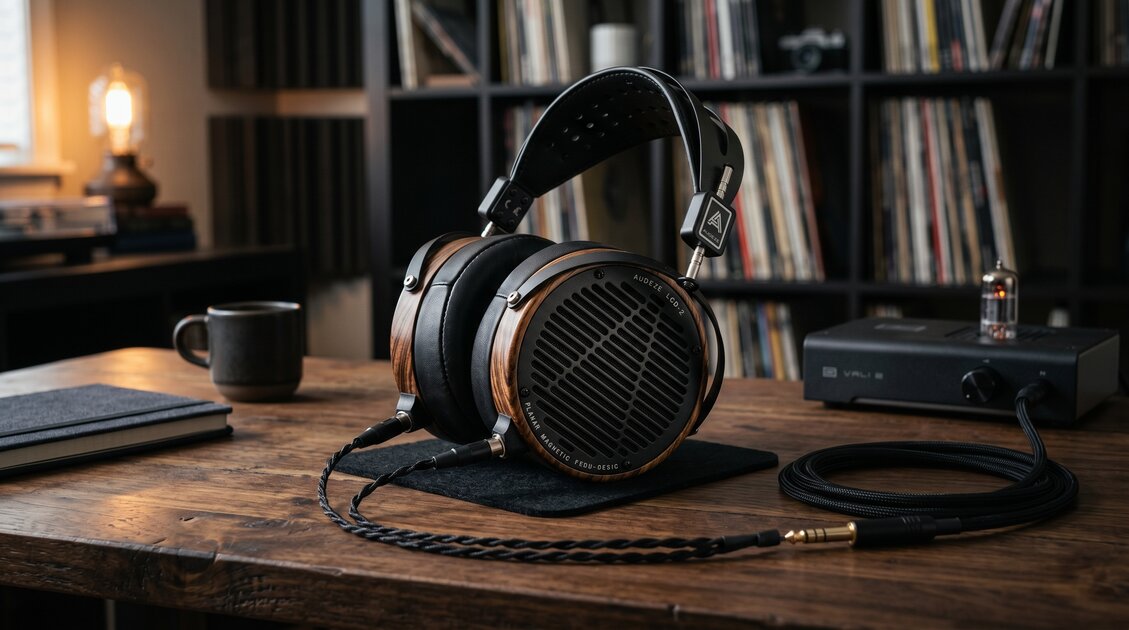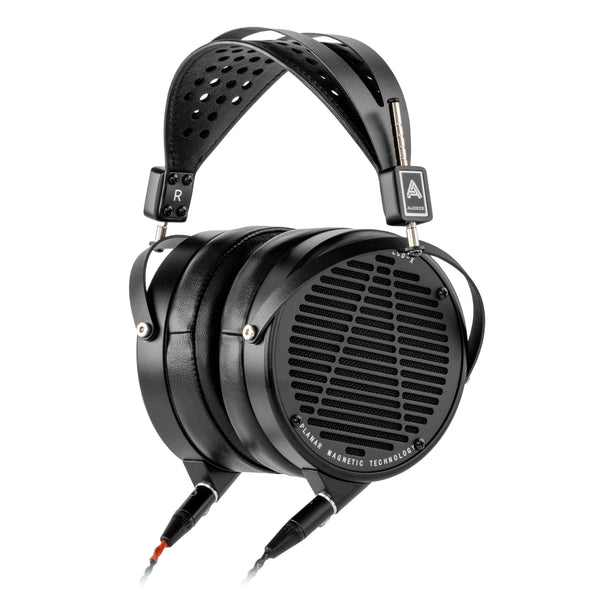
The Audeze LCD-X has earned a reputation that few audiophile headphones achieve: genuine adoption in professional studio environments. Walk into serious mixing rooms in Los Angeles, Nashville, or London and you’ll find LCD-X headphones on more than a few consoles. That isn’t marketing—it’s the result of a headphone that professional engineers determined was good enough to trust their mixes to.
What makes the LCD-X different from consumer audiophile headphones isn’t just accuracy. It’s a specific combination of qualities that professional applications demand: controlled frequency response, low harmonic distortion, fast transient response, and the ability to reveal problems in a mix that cheaper headphones hide. The LCD-X delivers all of these, though not without meaningful tradeoffs that any potential buyer should understand before committing.
Specifications
| Spec | Value |
|---|---|
| Driver Type | Planar magnetic, Fazor waveguide elements |
| Impedance | 20 Ω |
| Sensitivity | 100 dB / 1mW |
| Frequency Response | 10 Hz – 50 kHz |
| THD | < 0.1% at 100 dB |
| Driver Size | 106mm |
| Weight | 596 g (2021+ version) |
The 20-ohm impedance is low, and the 100 dB/mW sensitivity means the LCD-X is not particularly demanding to drive loud. However, low impedance doesn’t mean it sounds its best from any source—the amplifier’s current delivery capability significantly affects bass control and overall dynamic presentation. The 2021 “Creator Edition” revision reduced weight to approximately 596g from earlier versions that exceeded 600g, a modest improvement that doesn’t fundamentally change the comfort situation.
Audeze’s Fazor waveguide technology is integrated into the magnet structure and serves a specific acoustic function: improving phase coherence across the driver’s surface. The practical result is better bass definition and improved transient accuracy compared to Audeze designs without Fazor elements.
Design and Build
The LCD-X uses Audeze’s established LCD platform with machined aluminum cups, custom earpads, and a sprung steel headband that accommodates a wide range of head sizes. The chassis is genuinely premium—anodized aluminum throughout, precision-machined grilles, and hardware that feels like it was specified for long-term professional use rather than consumer retail appeal.
The earpads are large, and the 2021 revision uses improved materials and geometry that provide better long-term comfort and more consistent acoustic seal than earlier pad configurations. The choice between leather and velour pads is available as an option; velour runs slightly cooler in warm environments, while leather provides a marginally better seal.
The detachable cable system uses dual mini-XLR connectors at each cup—robust, secure, and enabling straightforward aftermarket cable upgrades for those who want balanced connections or specific cable character.
The weight is the LCD-X’s defining physical limitation, and there’s no softening this: at 596g, it’s one of the heavier headphones commercially available. Wearing it for 30 minutes is comfortable. Wearing it for three hours of mixing work produces meaningful neck and ear fatigue. This is not a headphone for passive, reclined listening. Professional engineers who use it for extended sessions typically take regular breaks.
Sound Signature
Bass
The LCD-X’s bass is its most distinctive characteristic. The 106mm planar magnetic driver moves substantial air, and the result is bass reproduction with a combination of extension, texture, and controlled impact that few headphones at any price match. Sub-bass reaches cleanly below 20 Hz with real presence. The midbass is punchy and well-defined without the bloom that characterizes poorly-controlled dynamic drivers.
For mixing applications, what matters most is bass texture and accuracy. When a mix has a problematic low-frequency element—a resonant bass note, a muddy kick drum—the LCD-X surfaces it clearly rather than hiding it under warmth or boom. This is exactly what professional engineers need: not the headphone that makes everything sound good, but the headphone that reveals everything precisely.
Audeze’s Fazor elements contribute directly to bass quality. The improved phase coherence across the driver surface means that bass notes decay realistically, preserving the acoustic character of recording spaces and instrument resonance patterns.
Midrange
Reference-tuned with careful attention to frequency balance through the critical 500 Hz–4 kHz range where most instruments and voices live. The LCD-X doesn’t flatter recordings—it reveals them. Vocals are rendered with accurate tonal balance; instruments sit in the mix at their recorded positions without the headphone’s own character pushing them forward or backward.
Some listeners who encounter the LCD-X coming from consumer audiophile headphones find the midrange slightly dry or analytical. This is a calibrated response to professional requirements, not a limitation. If you want your mixing headphone to editorialize about the music’s quality rather than report it accurately, you want a different product.
Imaging and detail retrieval are where the LCD-X truly earns its professional reputation. You can hear the position of reverb tails, the exact character of subtle EQ adjustments in a mix, the amount of compression applied to individual channels, and spatial decisions that lower-resolution headphones simply don’t communicate. This level of resolution makes mixes easier to analyze and problems faster to identify.
Treble
Controlled and accurate, with slightly less high-frequency emphasis than HiFiMAN planar headphones at comparable prices. The treble extends adequately and retrieves detail without the brightness or artificial sparkle that some consumer headphones add to create a sense of clarity that isn’t genuinely in the recording.
For mixing work, this matters: a headphone that artificially brightens the treble will cause engineers to undercompensate for high frequencies in their mixes, resulting in mixes that sound dark on other systems. The LCD-X’s accurate treble gives engineers a reliable reference point.
For purely audiophile listening, the treble character reads as “dark” compared to HiFiMAN alternatives and the Sennheiser HD 800S. Cymbal detail and string harmonics are present and accurate but less forward than on competing headphones. The Chord Mojo 2 pairs well with the LCD-X, providing a clean source that brings out the headphone’s detail without adding brightness.
Soundstage and Imaging
The LCD-X presents a focused, precise soundstage—wider than typical closed-back headphones but narrower than the HiFiMAN Arya or Sennheiser HD 800S. What the soundstage lacks in width it compensates for in precision: instrument positions within the stereo field are accurately rendered, and the imaging stability across different types of music is excellent.
For mixing, a focused soundstage is an advantage. Wide, diffuse staging makes it harder to judge center-image density and accurate instrument placement. The LCD-X’s controlled presentation keeps everything clearly organized.
Amplification
At 20 ohms, the LCD-X is less demanding than high-impedance dynamic driver headphones, but it still benefits significantly from quality amplification. Specifically, amplifiers with adequate current delivery (not just voltage) improve the bass control and dynamic presentation. The Sennheiser HD 800S comparison is instructive: both headphones sound better with quality amplification, but the LCD-X’s lower impedance means it’s more tolerant of lower-powered sources.
For professional use, a dedicated desktop DAC/amp stack is appropriate. The Chord Mojo 2, Topping A90 Discrete, or similarly capable desktop solutions all work well. The LCD-X’s sensitivity to source quality means upgrading from a mediocre DAC/amp to a quality one produces audible improvements in bass tightness and overall resolution.
For more headphone and source pairing options, see our Best Headphones Under $1000 guide for contextual comparisons.
Who Should Buy the LCD-X?
- Music producers, mixing engineers, and mastering engineers who need reliable reference headphones
- Audiophiles who prioritize analytical precision, detail retrieval, and accurate frequency balance
- Listeners whose primary genres depend on bass accuracy: jazz, classical, acoustic, R&B
- Those with a desktop amplification setup who can give the LCD-X appropriate power and a clean source
- Consumers who want professional-grade build quality that will last with proper care
Who Should NOT Buy the LCD-X?
- Anyone with neck or shoulder sensitivity—596g will cause fatigue during extended sessions
- Listeners who want warmth, wide soundstage, or high-frequency sparkle—the LCD-X is analytical, focused, and somewhat dark
- Those without proper desktop amplification
- Casual listeners for whom the analytical presentation feels sterile or unengaging
- Portable listeners—this is a pure desktop product
Pros & Cons
Pros:
- Accurate, professionally trusted reference tuning with industry adoption to prove it
- Extraordinary bass texture and controlled impact from the 106mm planar driver
- Fazor elements provide superior phase coherence versus standard planar designs
- Low THD (< 0.1%) and high detail retrieval make mix analysis genuinely easier
- Durable, premium aluminum construction built for long-term professional use
- Replaceable pads and cables support long ownership
Cons:
- Weight (~596g) limits comfortable session length—a real constraint for extended work
- Darker treble character reads as dry or analytical compared to HiFiMAN alternatives
- More intimate soundstage than Arya or HD 800S alternatives
- Expensive—the professional-grade quality comes at a professional-grade price
- Requires desktop amplification to sound its best
Frequently Asked Questions
Q: Is the LCD-X overkill for home listening (not mixing)?
Not if you value analytical accuracy and bass texture in your listening. Many audiophiles who don’t professionally mix use the LCD-X because they prefer its precisely controlled character over the wider, more colored presentations of competing headphones. The question is whether its character aligns with how you enjoy music—if you want to analyze what you’re hearing rather than simply experience it, the LCD-X is appropriate.
Q: How does the 2021 Creator Edition compare to earlier LCD-X versions?
The 2021 revision reduced weight slightly, improved the earpads, and refined the overall package without fundamentally changing the acoustic character. Earlier LCD-X versions sound comparable, but the revised pads and reduced weight make the 2021 and later versions more practical for extended sessions.
Q: Does the LCD-X work well for gaming?
It can, particularly for gamers who also use it for music and who value positional audio accuracy. The precise imaging and bass impact make first-person shooters and cinematic games satisfying. However, the weight becomes an issue during long gaming sessions, and the lack of a microphone means a separate mic solution is necessary.
Conclusion
The Audeze LCD-X in 2026 is what it has always been: a precision reference instrument that professionals trust because it tells the truth about recordings rather than flattering them. Its weaknesses—weight, analytical character, dark treble—are the direct consequences of design decisions made in service of accuracy. There is no version of this headphone that addresses those tradeoffs while preserving what makes it professionally valuable.
For mixing engineers, the LCD-X is among the most reliable headphone references available, period. For audiophile listeners who share its preference for accuracy over musicality, it’s one of the most technically accomplished headphones in its price tier. For everyone else, there are headphones better suited to the combination of warmth, width, and comfort that casual listening demands.
The LCD-X earns its continued relevance not by appealing to everyone, but by serving its target audience exceptionally well.