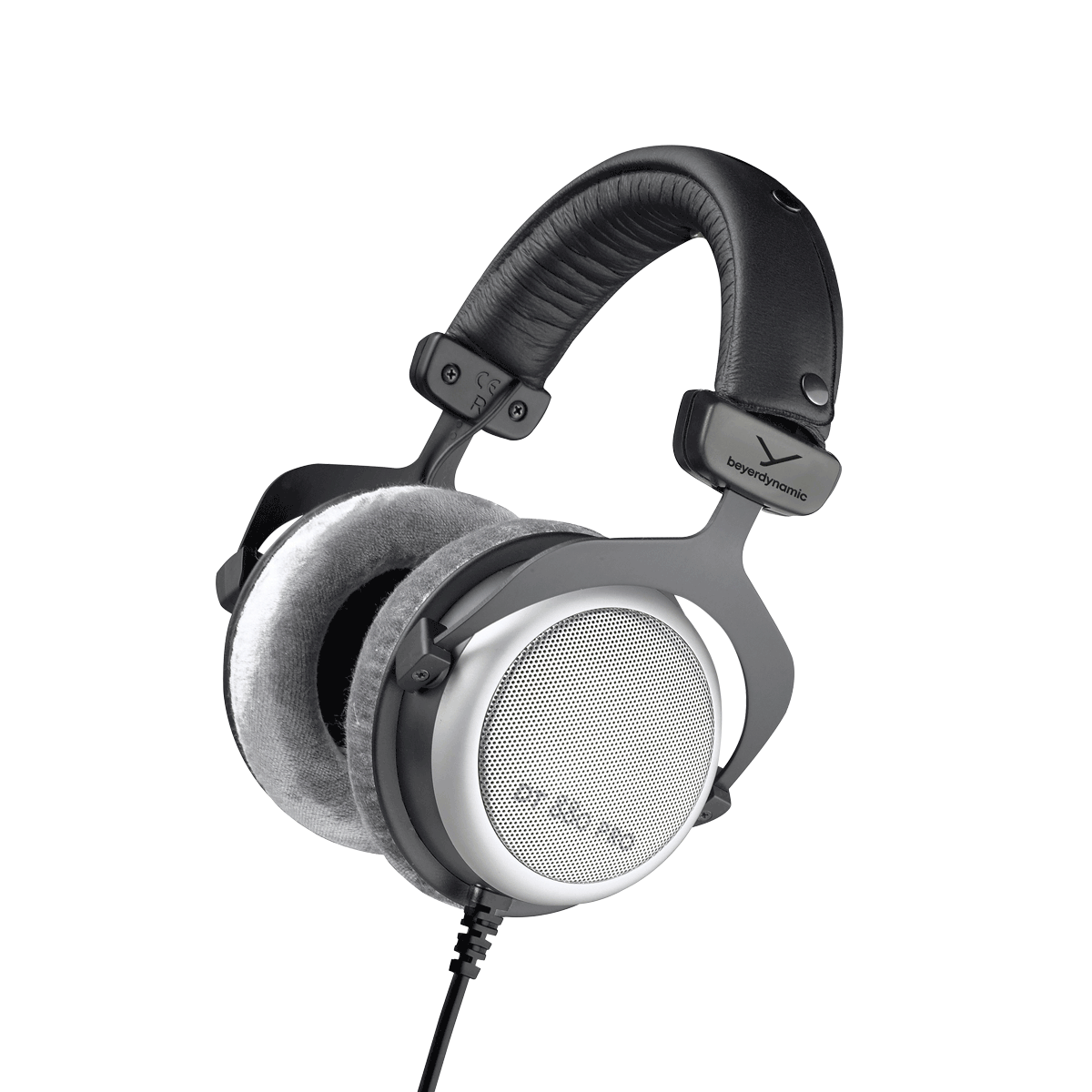
In the world of professional audio, few tools have achieved the status of the Beyerdynamic DT 880 Pro. Originally released in the early 2000s, this semi-open headphone became an immediate staple of broadcast, tracking, and monitoring environments globally. In 2026, the question isn’t whether it was “good”—it clearly was—but whether it remains a relevant tool in a landscape that has shifted toward more sophisticated driver designs, higher-resolution digital sources, and a wider variety of professional and consumer competition.
The short answer is yes. The DT 880 Pro remains one of the most reliable, predictable, and cost-effective monitoring tools available to sound professionals and serious listeners alike.
Specifications
| Spec | Value |
|---|---|
| Driver Type | Dynamic, semi-open |
| Impedance | 250 Ω |
| Sensitivity | 96 dB SPL / 1mW |
| Frequency Response | 5 – 35,000 Hz |
| THD | < 0.1% |
| Weight | 290 g |
The 250-ohm impedance is a hallmark of the DT 880 Pro. It requires a dedicated amplifier to perform as intended; plugging this directly into a laptop headphone jack usually results in a thin, weak, and distorted sound that misrepresents the driver’s capability. The 96 dB sensitivity is low—typical of studio headphones designed for professional amplification circuits rather than low-voltage consumer sources.
Design and Build
Beyerdynamic’s build philosophy for the DT 880 Pro is “function over form.” It features industrial-strength construction: a metal headband, hard plastic ear cups, and replaceable velour pads. This is a design built to be serviced rather than discarded; parts for the DT 880 are readily available, and the headphone is famously repairable by any technician with basic tools.
The “semi-open” design strikes a specific balance. It provides more isolation than a fully open-back headphone like a Sennheiser HD 600, yet maintains a more natural, less pressurized soundstage than a fully sealed closed-back headphone. This makes it an ideal “all-rounder” for tracking and monitoring.
Comfort is excellent for extended sessions. The velour pads are soft, breathable, and conform well to most head shapes. At 290g, it’s light enough that the clamping force (which is moderately tight, typical for studio gear to ensure isolation) doesn’t feel fatiguing.
Sound Signature
Bass
The DT 880 Pro has a neutral, controlled bass response that is neither lean nor boosted. It lacks the deep, sub-bass extension of modern planar magnetics, but it delivers tight, accurate midbass that’s ideal for critical monitoring. For mixing work, this bass character is an advantage—it provides the reference accuracy required to make mix decisions without flattering the low end.
Midrange
Flat and revealing. There is a slight brightness in the upper midrange (roughly 2–4 kHz) that makes voices and transient details feel very immediate. This emphasis is a deliberate design choice that aids in identifying compression artifacts, vocal sibilance, or EQ issues in a mix. For critical monitoring, this is a tool; for purely casual listening, some users find it a bit “forward.”
Treble
This is the DT 880 Pro’s signature character. Beyerdynamic is famous for their “Beyer Peak”—an emphasis in the treble (typically between 7 and 10 kHz) that enhances the perception of detail and clarity. The DT 880 Pro has this characteristic, though it’s smoother and less aggressive than the peak found in the DT 770 or DT 990 Pro. It makes the headphone sound “detailed” and “bright,” which helps in detecting high-frequency noise, mouth clicks, or harshness in recordings. On poorly mastered music, it can be fatiguing. On high-resolution, well-mastered tracks, it provides an airy, hyper-clear sensation.
Soundstage
The semi-open nature provides a balanced spatial presentation—wider and more natural than most closed-back headphones, but more focused than fully open-back audiophile flagships. Imaging is precise: in tracking and mixing applications, you can reliably place instruments within the stereo field.
Source Pairing and Professional Application
The DT 880 Pro is an analytical headphone, not a musical one. It works beautifully with clean, neutral solid-state amplifiers that don’t add coloration. Because of the treble character, some users prefer pairing it with warm or tube amplification to “tame” the brightness, but for its intended professional use, an accurate, neutral source is better to avoid masking details.
For desk use, pairing it with a professional-grade DAC/amp like the Topping DX3 Pro+ or FiiO K7 provides exactly the power and neutrality the 250-ohm driver needs to perform consistently.
Who Should Buy the DT 880 Pro?
- Sound professionals needing a reliable, reference-accurate tool for monitoring, tracking, and mixing
- Audiophiles who prefer an analytical, detailed sound signature over a warm/musical one
- Listeners whose source chain is neutral and who want to hear the truth about their recordings
- Users who need a durable, repairable, long-term headphone investment
- Those who want the best balance of semi-open isolation and natural soundstage for studio work
Who Should NOT Buy the DT 880 Pro?
- Bassheads or listeners wanting a colored, “musical” presentation
- Those who are sensitive to treble energy—the Beyer treble peak will cause fatigue for some users
- Listeners without a desktop amplifier—the 250-ohm driver requires it
- Anyone wanting a headphone for portable use—the cable length (typical 3m) and power requirements make this impractical for travel
Pros & Cons
Pros:
- Exceptional frequency balance for mixing and reference work
- Predictable, accurate sound signature that professionals rely on
- Industry-leading durability and repairability
- Comfortable for long-form monitoring sessions
- Best-in-class price-to-performance for a professional tool
Cons:
- “Beyer Peak” treble character can be fatiguing on bright recordings
- 250 ohms requires a quality desktop amplifier
- Utility is restricted to professional/desktop environments; not portable
- Design is industrial and utilitarian, not luxury
Frequently Asked Questions
Q: Is the DT 880 Pro still worth buying with newer products on the market?
Yes. While newer driver technologies offer different spatial or technical performance, few products offer the same balance of reliability, neutrality, and professional trust that the DT 880 Pro has earned over two decades. It’s a “known entity” in the audio world, which makes it easier for engineers to make decisions based on it.
Q: Can I use it for gaming?
It’s excellent for gaming if you have an amp. The imaging precision is superb, and the treble emphasis helps reveal environmental details (footsteps, ambient audio cues). It’s frequently used by pro-level competitive gamers for this reason.
Q: Does it need to be broken in?
Beyerdynamic headphones exhibit minimal measurable change after burn-in. Don’t worry about it.
Conclusion
The DT 880 Pro in 2026 is a success story of consistency. It hasn’t tried to be the newest, flashiest, or most expensive headphone—it has simply remained a reliable, accurate tool that fulfills its professional promise every single time it’s used. For anyone who values analytical detail, spectral neutrality, and a tool that works as expected in professional or critical listening environments, it remains one of the best investments an audiophile or engineer can make. It doesn’t need to be better than 2026 flagships to be worth owning—it just needs to be the professional standard it has always been.